
Every parent preparing a child for AISSEE eventually faces the same question:
“Which topics should my child concentrate on the most?”
The syllabus provides a list of chapters, but it does not reveal how questions are framed, which concepts return regularly or how the paper has changed over time.
That is where AISSEE Class 6 Previous Year Question Papers become valuable.
Mandharai Academy analysed six Class 6 papers from 2021 to 2026 across Mathematics, Language, Intelligence and General Knowledge. The objective was not to predict exact questions. It was to identify recurring concepts, stable patterns and changes in question presentation.
The analysis produced one clear conclusion:
AISSEE does not usually repeat an entire paper, but it repeatedly tests the same core concepts through different situations, values and question formats.
Students who recognise these patterns can prepare more intelligently instead of treating every chapter as equally important.
What This Six-Year AISSEE Analysis Covers
The analysis includes one English-medium Class 6 paper from each year between 2021 and 2026.
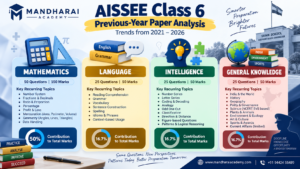
Across the six papers, the broad structure remained stable:
| Section | Questions | Marks per question | Total marks |
|---|---|---|---|
| Mathematics | 50 | 3 | 150 |
| Language | 25 | 2 | 50 |
| Intelligence | 25 | 2 | 50 |
| General Knowledge | 25 | 2 | 50 |
| Total | 125 | — | 300 |
Mathematics alone accounts for half of the total marks. However, the other three sections together contribute the remaining 150 marks. Ignoring GK, Language or Intelligence can therefore seriously affect a student’s total score.
Parents should always confirm the final pattern and instructions through the official NTA AISSEE portal. Information about Sainik Schools and admissions is also available through the Sainik Schools Society.
AISSEE Class 6 Previous Year Question Papers: Overall Trends
Five major trends were visible across the six papers.
1. The syllabus remained stable, but presentation evolved
The main topics did not change dramatically. Fractions, decimals, angles, mensuration, grammar, vocabulary, series, analogies and EVS-based GK appeared consistently.
What changed was the way these concepts were tested.
Recent papers included more:
- Statement-based questions
- Assertion-and-reason formats
- Match-the-list questions
- Real-life mathematical situations
- Multi-step calculations
- Questions requiring comparison or elimination
- Visual reasoning and figure-based interpretation
A child who only memorises formulas may struggle when a familiar concept is placed inside an unfamiliar situation.
2. Mathematics remained the decisive section
Mathematics consistently contained 50 questions for 150 marks. The papers repeatedly tested a broad combination of arithmetic, geometry and real-life applications.
The section was not simply about knowing formulas. Students needed to:
- Read word problems accurately
- Identify the required operation
- Convert units correctly
- Complete calculations without careless errors
- Compare similar-looking answer choices
- Manage time across 50 questions
3. Intelligence rewarded pattern familiarity
Number series, letter series, analogies, odd-one-out questions and visual patterns appeared repeatedly.
These questions become much easier when students have already encountered the underlying model. Unfamiliarity—not difficulty—is often the main reason children lose marks in Intelligence.
4. Language tested practical grammar
The Language section consistently combined:
- Reading comprehension
- Grammar
- Vocabulary
- Sentence construction
- Spelling
- Idioms and phrases
Recent papers continued to test familiar grammar rules but often placed them inside complete sentences. Students must understand how a word functions in context rather than memorising definitions alone.
5. GK relied heavily on static knowledge and NCERT EVS
The GK papers contained a strong mix of:
- Everyday science
- Plants and animals
- Food and health
- Water and environment
- Indian history
- Geography
- Art and culture
- National personalities
- Sports and awards
- Limited current affairs
Several concepts were repeated across consecutive papers, especially from NCERT EVS-style content.
Year-by-Year Development from 2021 to 2026
| Year | Important observations |
|---|---|
| 2021 | Mathematics was calculation-heavy, with HCF, LCM, ratio, profit and loss, average, percentages and geometry. GK mixed science, environment, culture, defence and awards. |
| 2022 | Greater use of figures, graphs and applied number problems was visible. Intelligence included diagrams, coded relationships and logical arrangements. |
| 2023 | Statement-based and match-the-list formats became more noticeable. Mathematics required stronger interpretation, while GK showed a close relationship with EVS and static Indian knowledge. |
| 2024 | Fractions, percentage, angles, mensuration, number properties and simple interest remained prominent. GK became strongly aligned with everyday EVS concepts. |
| 2025 | Several questions combined concepts with real situations. Assertion-and-reason, statement evaluation and cross-topic mathematical applications became more frequent. |
| 2026 | The stable blueprint continued, but structured formats such as matching, statement evaluation and applied reasoning remained important. Several GK concepts from 2025 appeared again. |
The overall difficulty did not simply increase every year. Instead, the papers gradually required students to understand familiar ideas in more structured and varied formats.
Mathematics Trends in AISSEE Class 6 Previous Year Question Papers
Mathematics is the most important scoring area because it carries 150 out of 300 marks.
Fractions and decimals appeared every year
Recurring models included:
- Comparing fractions
- Arranging fractions in ascending or descending order
- Addition and subtraction of fractions
- Finding the remaining fraction
- Converting fractions into decimals
- Decimal operations
- Applying fractions to time, quantities and real-life situations
In 2021, students were asked to identify and arrange fractions. Similar ordering and comparison questions appeared again in 2022, 2023, 2024, 2025 and 2026.
The numbers changed, but the required skill remained the same.
HCF, LCM and divisibility remained dependable topics
HCF and LCM appeared through models such as:
- Finding the other number using HCF and LCM
- Finding the greatest possible equal length
- Finding the least number satisfying a condition
- Numbers leaving the same remainder
- Divisibility statements
- Prime and composite numbers
These models appeared repeatedly from 2021 through 2026. Students should understand why a problem requires HCF or LCM rather than relying only on memorised procedures.
Geometry became increasingly conceptual
Frequently tested geometry areas included:
- Types of angles
- Complementary and supplementary angles
- Angles in figures
- Properties of circles
- Radius, diameter, chord and arc
- Types of triangles
- Perimeter and area
- Cube and cuboid volume
From 2023 onward, several geometry questions used statements, diagrams or matching formats. This means children must recognise properties visually and conceptually.
Percentage, ratio and commercial arithmetic were consistent
Common applications included:
- Profit and loss
- Percentage increase or decrease
- Finding a number from its percentage
- Ratio distribution
- Sharing money in a given ratio
- Simple interest
- Cost-price and selling-price problems
These were frequently presented as stories involving shops, loans, businesses, school marks or everyday purchases.
Measurement, temperature and unit conversion gained importance
The papers repeatedly used:
- Kilograms and grams
- Litres and millilitres
- Metres and centimetres
- Time conversion
- Speed, distance and time
- Celsius and Fahrenheit
- Perimeter-based fencing
- Volume and capacity
Temperature conversion appeared prominently in the papers from 2023 onward. Students should therefore practise conversions as complete word problems, not just learn the formulas.
Mathematics priority list for AISSEE 2027
Based on the six papers, students should prioritise:
- Fractions and decimals
- Angles, circles and triangles
- Area, perimeter and volume
- HCF, LCM and divisibility
- Percentage, profit and loss
- Ratio and proportion
- Simple interest
- Average
- Speed, distance and time
- Units, temperature and measurement
- Roman numerals
- Number system and place value
Intelligence Trends in AISSEE Class 6 Previous Year Question Papers
The Intelligence section remained highly pattern-oriented.
The most consistent question families were:
- Number series
- Letter series
- Verbal analogy
- Number analogy
- Odd one out
- Coding and decoding
- Alphabetical order
- Logical sequence
- Blood relations
- Direction sense
- Ranking
- Mirror and water images
- Embedded figures
- Figure completion
- Figure matrix
- Counting triangles
- Coded mathematical operations
Series and analogies formed the foundation
Every year included questions based on identifying a relationship and continuing it.
The relationship could involve:
- Addition or subtraction
- Multiplication
- Alphabet positions
- Reversal of letters
- Alternating patterns
- Relationship between objects
- A profession, place, instrument or unit
Students should learn to ask, “What changed between the first two terms?” before checking the options.
Visual reasoning remained essential
Mirror images, water images, pattern completion, embedded figures and figure analogies were repeatedly tested.
These cannot be mastered through reading alone. Children need regular visual practice and must learn to check:
- Direction
- Rotation
- Shape count
- Position
- Shading
- Line movement
- Addition or removal of elements
Dictionary order gained consistency
Alphabetical arrangement appeared in multiple recent papers, including 2023, 2024, 2025 and 2026.
This is a high-return topic because the rule is simple, but students often make mistakes after comparing only the first letter.
They must compare words letter by letter until the first difference appears.
Language Trends in AISSEE Class 6 Previous Year Question Papers
The Language section consistently tested practical usage.
Reading comprehension was present every year
The passages covered accessible topics such as:
- Greek mythology
- Wonders of the world
- History of postage stamps
- Pashmina shawls
- Conversation skills
- Dr. A. P. J. Abdul Kalam
Questions tested:
- Direct facts
- Incorrect statements
- Word meanings
- Vocabulary in context
- Central ideas
- Parts of speech
- Information-based inference
The 2026 passage on Dr. Kalam shows how comprehension can overlap with general awareness. Students must read every detail carefully instead of depending on what they already know about the topic.
Grammar areas repeated consistently
High-frequency grammar topics included:
- Articles
- Prepositions
- Tenses
- Pronouns
- Nouns
- Adjectives
- Adverbs
- Verbs
- Conjunctions
- Question tags
- Degrees of comparison
- Singular and plural forms
- Types of sentences
- Sentence improvement
- Jumbled sentences
Vocabulary remained a reliable scoring area
Recurring vocabulary models included:
- Synonyms
- Antonyms
- Correct spelling
- Homophones
- Idioms
- Phrases
- One-word meanings
- Profession-related vocabulary
A student who learns only long word lists may not improve sufficiently. Vocabulary should be practised through sentences, passages and short daily revision.
GK Trends in AISSEE Class 6 Previous Year Question Papers
The strongest GK finding is the repeated dependence on static GK and NCERT EVS-style concepts.
Science and everyday environment dominated
Frequently tested areas included:
- Plants and plant parts
- Seeds and germination
- Water and water conservation
- Food preservation
- Human body and health
- Diseases
- Animals and their senses
- Soil and earthworms
- Natural resources
- Fuels
- Planets and space
- Measurement instruments
Indian history, geography and culture remained important
Students were repeatedly tested on:
- National symbols
- Freedom movement
- Monuments
- Rivers and cities
- States and cultural traditions
- Classical and folk dances
- Books and authors
- Famous personalities
- Sports achievements
- International organisations
Current affairs had a limited but visible role
Current events appeared, but they did not dominate the section. For example, the 2024 paper included a question related to India’s gold medals at the 2023 Asian Games.
This indicates that students need age-appropriate current affairs, but static GK and EVS should receive more preparation time.
Exact and Near-Exact GK Repeats Found in Recent Papers
The 2025 and 2026 papers contained several striking repetitions:
| Repeated concept | 2025 | 2026 |
|---|---|---|
| Process of making salt from seawater | Yes | Yes |
| Why people float in the Dead Sea | Yes | Yes |
| Karnam Malleswari and weightlifting | Yes | Yes |
| Bachendri Pal and Mount Everest | Yes | Yes |
| Golconda Fort and Hyderabad | Yes | Yes |
| Ronald Ross and malaria | Yes | Yes |
| Dandi March in 1930 | Yes | Yes |
| Abu Dhabi as the capital of the UAE | Yes | Yes |
Other concepts also returned across wider intervals. For example, the instrument used to measure vehicle speed appeared in both the 2021 and 2023 papers.
This does not mean students should memorise only repeated answers. It shows that high-frequency static facts and NCERT EVS concepts deserve systematic revision.
What the Trends Mean for AISSEE 2027 Preparation
The six-year analysis suggests five clear preparation rules.
1. Do not prepare every topic with equal intensity
Complete syllabus coverage is necessary, but recurring topics should receive more practice and revision.
2. Practise question models, not just chapter names
“Fractions” is a chapter. However, AISSEE may test it through comparison, ordering, remaining quantity, decimal conversion or a word problem.
Students must practise all major models within each chapter.
3. Use PYQs diagnostically
After solving a paper, classify every mistake as:
- Concept not understood
- Formula forgotten
- Calculation error
- Question misread
- Option-selection error
- Time-pressure error
- Unfamiliar question model
This classification reveals what must be corrected.
4. Combine static GK with NCERT EVS
For GK preparation, focus on:
- NCERT EVS concepts
- High-frequency static GK
- India-related facts
- Defence awareness
- Maps and locations
- Limited child-friendly current affairs
5. Include statement and matching questions
Students preparing only through direct one-line MCQs may be surprised by recent papers. Practice should also include:
- Statement I and Statement II
- Assertion and reason
- Match List I with List II
- Correct sequence
- Multiple-condition questions
How to Use AISSEE Class 6 Previous Year Question Papers
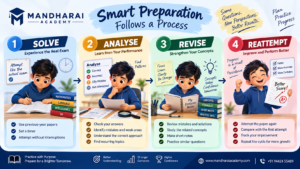
A productive PYQ routine should have four stages.
Stage 1: Solve without a timer
Use the first paper to understand the question types. Mark unfamiliar models and revise the concepts behind them.
Stage 2: Solve section-wise with time limits
Complete Mathematics, Language, Intelligence and GK separately. Record accuracy and time for each section.
Stage 3: Attempt full papers under exam conditions
Use a 150-minute timer, sit without interruptions and practise careful OMR marking.
Stage 4: Reattempt incorrect questions
After seven days, solve every incorrect or skipped question again without looking at the solution.
Students can use the Mandharai Academy AISSEE 2027 Test Series for structured topic-wise tests and full-length mock practice.
A Relatable Student Scenario
Imagine two students, Arun and Nila.
Arun reads every chapter once and immediately moves to the next book. He feels busy, but he does not know which question models cause him difficulty.
Nila solves one previous-year paper, records every mistake and discovers three patterns:
- She understands fractions but makes comparison errors.
- She knows GK facts but forgets state-location pairs.
- She solves Intelligence questions correctly but takes too long.
During the next two weeks, Nila practises those three areas. When she attempts another paper, her score and speed improve.
The difference is not intelligence. It is feedback.
Previous-year papers become powerful only when students learn from their mistakes.
How Mandharai Academy Helps Students Apply These Trends
Knowing the trends is only the first step. Students also need regular teaching, practice and correction.
The AISSEE Class 6 online coaching programme at Mandharai Academy supports students through:
- Live concept-based classes
- Topic-wise practice
- Weekly tests
- Previous-year question models
- Full-length mock examinations
- OMR practice
- Doubt clarification
- Performance tracking
- Parent progress updates
- Personal mentoring from a Sainik School alumnus
Final Takeaway
The AISSEE Class 6 Previous Year Question Papers from 2021 to 2026 show a stable syllabus but an evolving presentation style.
The most important conclusions are:
- Mathematics remains the deciding section.
- Fractions, geometry, arithmetic and number concepts recur consistently.
- Intelligence depends heavily on familiarity with standard patterns.
- Language rewards contextual grammar and careful reading.
- GK is strongly connected to NCERT EVS and static Indian knowledge.
- Statement-based and matching formats require dedicated practice.
- Some GK concepts have repeated across consecutive years.
- Analysing mistakes is more valuable than simply counting completed papers.
Previous-year papers should guide preparation—not replace complete syllabus learning.
For structured AISSEE 2027 exam coaching, training and mock-test practice, contact Mandharai Academy:
- Phone/WhatsApp: +91 94424 55489
- Email: mandharaiacademy@gmail.com
- Instagram: Mandharai Academy
- Facebook: Mandharai Academy Facebook
Start with one previous-year paper, identify one weakness and improve it systematically. That is how practice becomes progress.