
AISSEE Intelligence Test PYQ Analysis: Question Types and Trends
A student solves ten number-series questions correctly at home. Naturally, the parents feel confident about the Intelligence section. But during a mock test, the same student encounters coding-decoding, dictionary order, mirror images, blood relations and figure analogies—and suddenly begins losing marks.
This is a common AISSEE preparation problem.
The Intelligence section does not test one isolated reasoning skill. It checks whether a student can identify relationships, follow patterns, arrange information logically and solve unfamiliar-looking problems within a limited time.
However, the section is not completely unpredictable.
Our AISSEE Intelligence Test PYQ Analysis of the six supplied Class 6 papers from 2021 to 2026 shows that certain question models appear consistently. The letters, numbers, words or figures may change, but the underlying logic frequently remains the same.
Series completion, analogy, classification, logical order, alphabetical arrangement and figure reasoning are among the most dependable areas. Direction sense, blood relations, coding-decoding, mathematical operations and ranking also appear, although their frequency varies from year to year.
Analysis note: This article examines 150 Intelligence questions—25 questions from each of the supplied AISSEE Class 6 papers from 2021 to 2026. Some graphical questions required visual interpretation, and certain questions fit more than one reasoning category. Therefore, the frequency levels in this article are preparation-based classifications, not an official topic-wise allocation.
AISSEE Intelligence Test PYQ Analysis: Quick Findings
The six-year analysis revealed seven important trends:
- Series and pattern-completion questions appeared every year.
- Analogy remained one of the most consistent question types.
- Classification and odd-one-out questions were especially prominent from 2023 onwards.
- Alphabet-based reasoning became more visible in recent papers.
- Non-verbal reasoning appeared regularly but did not dominate the entire section.
- Traditional topics such as directions, ranking and coding were more noticeable in some years than others.
- The examination repeats question models more often than it repeats identical questions.
This final point is important.
In GK, a factual question may return with nearly the same answer. In Intelligence, the examination is more likely to reuse a logical structure while changing the numbers, letters, figures or names.
For example:
- A number series may use a different starting number.
- A coding rule may use a different word.
- A blood-relation question may change the family members.
- A mirror-image question may use a new arrangement of symbols.
- A dictionary-order question may present a new group of words.
Students should therefore learn the method, not memorise the previous answer.
How We Analysed the Intelligence Questions
Each question from the supplied papers was grouped according to its main reasoning skill.
The broad categories included:
- Number series
- Letter and alphanumeric series
- Figure series
- Verbal analogy
- Number and letter analogy
- Figure analogy
- Classification and odd one out
- Coding-decoding
- Alphabet tests
- Dictionary order
- Word formation
- Logical sequencing
- Direction sense
- Blood relations
- Ranking and ordering
- Mathematical operations
- Number and figure matrices
- Mirror and water images
- Embedded figures
- Dice and spatial reasoning
- Figure counting
- Venn-diagram relationships
- Calendar and time-based reasoning
The analysis then examined three questions:
- Which models appeared across several years?
- Which models became more visible in recent papers?
- Which topics offer the best return for a student’s preparation time?
Students should combine this trend analysis with the latest AISSEE Class 6 syllabus and refer to the official NTA AISSEE portal and Sainik Schools Society for current examination notifications.
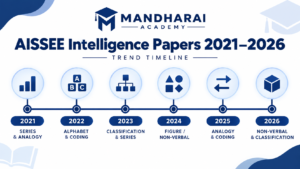
AISSEE Intelligence Test PYQ Analysis: Six-Year Overview
The overall Intelligence section remained stable at 25 questions in each supplied paper, but the balance of question types changed.
| Year | Major question types observed | Broad character of the paper |
|---|---|---|
| 2021 | Series, directions, ranking, blood relations, coding, analogy, operators and odd one out | Strong verbal and conventional reasoning |
| 2022 | Analogy, coding, series, ranking, order, directions, Venn diagrams, dice and embedded figures | Balanced verbal, numerical and visual reasoning |
| 2023 | Number series, analogies, logical order, dictionary order, classification, water image and figure reasoning | Heavy emphasis on analogy and classification |
| 2024 | Series, analogy, odd one out, logical order, dictionary order, mirror image and figure relationships | Pattern recognition and classification focused |
| 2025 | Missing letters, numerical patterns, figure series, logical order, word arrangement, mirror image, calendar and renaming | Greater variety in number, letter and figure models |
| 2026 | Number and letter series, analogy, alphabet tests, dictionary order, word formation, mirror image, figure counting, blood relations and operators | Balanced paper with strong alphabet and pattern emphasis |
The papers do not show a complete replacement of old topics. Instead, they show gradual changes in emphasis.
For example, directions and ranking were clearly visible in the earlier papers, while dictionary order, alphabet positioning and word-based reasoning became more noticeable from 2023 onwards.
Series and Pattern-Completion Questions
Series questions are among the most reliable topics in AISSEE Intelligence Test preparation.
They appeared in numerical, alphabetical, alphanumeric and visual forms across the six papers.
Examples of the underlying models included:
- Addition or subtraction by a fixed number
- Multiplication or division
- Increasing differences
- Alternating operations
- Position-based sequences
- Two letters changing simultaneously
- Missing letters within a continuous sequence
- A pattern developing from one figure to the next
The 2023 paper, for example, included number sequences based on subtraction and combined operations. The 2024 paper tested both letter and number series. The 2025 paper included number, letter and figure patterns. The 2026 paper again used number series, letter series and figural progression.
This tells students that learning only ordinary number series is not enough.
Series models students should practise
Students should be comfortable with:
- Addition series: 4, 8, 12, 16…
- Subtraction series
- Multiplication series
- Division series
- Square and cube patterns
- Increasing-difference series
- Alternating series
- Mixed-operation series
- Alphabet-position series
- Two-letter series
- Missing-letter groups
- Alphanumeric series
- Figure rotation and movement
- Addition or removal of shapes
A useful method is to ask four questions whenever a series appears:
- Is the value increasing or decreasing?
- Is the same operation repeated?
- Are the differences changing?
- Are alternate terms following separate rules?
Students should write the difference or operation above each pair of terms. This reduces guesswork.
Analogy Questions Remain a High-Priority Area
Analogy tests whether the student can identify a relationship in the first pair and apply it to a second pair.
This question type appeared consistently across the supplied papers.
The relationships included:
- Object and function
- Animal and shelter
- Instrument and measurement
- Profession and product
- Disease and affected organ
- Country and currency
- Sport and equipment
- Opposite ideas
- Letters transformed through a rule
- Numbers produced through an operation
- Figures rotated or rearranged
Representative models included relationships such as:
- Clock : Time :: Thermometer : Temperature
- Lion : Den :: Horse : Stable
- Cricket : Bat :: Hockey : Stick
- Country : Currency
- Book : Author :: Dish : Chef
The 2023 and 2024 papers were particularly rich in analogy questions, while the 2026 paper combined verbal, letter-number and figure analogies.
How to solve analogies correctly
Before looking at the answer choices, complete this sentence:
“The first item is related to the second because…”
For example:
“A clock measures time; therefore, a thermometer measures temperature.”
This is safer than selecting an option merely because two words appear connected.
For letter and number analogies:
- Convert letters into alphabetical positions.
- Check addition and subtraction.
- Observe whether letters are reversed or rearranged.
- Check whether different parts follow different rules.
- Apply the complete rule to the second pair.
Classification and Odd-One-Out Questions
Odd-one-out questions look simple, but the alternatives are often connected in more than one way. Students must identify the strongest common relationship.
The supplied papers tested classification through:
- Words
- Numbers
- Letter groups
- Places
- Musical instruments
- Seasons
- Institutions
- Food or plant categories
- Sports
- Planets and astronomical bodies
- Figures and symbols
Examples included identifying the item that differed among musical instruments, cities, seasons, educational institutions, planets and number groups.
The 2023, 2024 and 2025 papers contained several classification questions. A similar model continued in 2026 through categories such as sports and members of the solar system.
A three-step classification method
Students should:
- Find a property shared by at least three options.
- Check whether the fourth option clearly lacks that property.
- Avoid choosing based on a weak or accidental difference.
For numbers, test:
- Odd and even
- Prime and composite
- Perfect squares
- Multiples
- Digit sums
- Divisibility
- Reversal patterns
For words, check:
- Category
- Function
- Place
- Material
- Profession
- Living or non-living status
For letter groups, compare the gaps between consecutive letters.
Verbal and Alphabet-Based Reasoning Trends
Alphabet-based reasoning became especially important in the later papers.
The question types included:
- Dictionary order
- Alphabetical arrangement
- Position of a letter from the left or right
- Finding letters before or after a given position
- Forming a word using supplied letters
- Identifying a word that can be formed from a larger word
- Rearranging letters through a coding rule
- Completing a missing-letter series
Dictionary-order questions appeared in the 2023, 2024 and 2026 papers. The 2026 paper also included alphabet-position questions and word formation using the letters of “INTEREST.”
The 2025 paper asked students to rearrange letters to form a meaningful word and identify its category.
These questions reward accuracy more than advanced knowledge. A child may know the alphabet perfectly and still make mistakes by comparing only the first letter of each word.
Correct dictionary-order method
Compare words:
- Letter by letter
- From left to right
- Until the first different letter appears
If one word ends before the other and every earlier letter is identical, the shorter word comes first.
Students should also memorise:
- A = 1, B = 2, C = 3 … Z = 26
- Reverse positions: A = 26, B = 25 … Z = 1
- Opposite-letter pairs: A–Z, B–Y, C–X and so on
Coding-Decoding and Mathematical Operations
Coding-decoding questions appeared in different forms rather than as one fixed model.
The papers included:
- Direct letter substitution
- Reversal and rearrangement
- Word-to-number coding
- Renaming objects
- Symbol substitution
- Changed meanings of mathematical signs
In 2021, students had to identify a word transformation from a given code. The 2022 paper included word-to-number and rearrangement-based coding. The 2024 and 2026 papers used rearranged letter relationships, while the 2025 paper included a renaming model in which familiar objects were assigned different names.
Mathematical-operation questions appeared in years such as 2021, 2022 and 2026. In these questions, symbols such as addition, subtraction and multiplication were assigned new meanings.
The safest method is:
- Rewrite every symbol using its new meaning.
- Form the corrected expression.
- Apply BODMAS only after replacing the symbols.
- Calculate carefully.
Students often perform the operation before completing the substitution, which leads to avoidable errors.
Non-Verbal Reasoning in the Supplied Papers
Non-verbal reasoning appeared in every paper through one or more visual models.
The main types included:
- Figure analogy
- Figure series
- Mirror images
- Water images
- Embedded figures
- Missing figures
- Figure matrices
- Dice
- Shape identification
- Figure counting
- Venn-diagram relationships
The 2022 paper included Venn diagrams, dice and embedded-figure questions. The 2023 paper used water images and figure completion. The 2024 and 2025 papers included mirror images and figure relationships. The 2026 paper included mirror images, figure series, analogy and triangle counting.
Mirror image versus water image
Students should remember:
- A mirror image normally reverses left and right.
- A water image normally reverses top and bottom.
They should check:
- Position of dots
- Direction of arrows
- Open and closed sides
- Orientation of letters
- Location of small internal shapes
Figure analogy and series
In figure questions, look for:
- Rotation
- Reflection
- Addition of a line
- Removal of a shape
- Movement from one corner to another
- Change in shading
- Increase or decrease in quantity
- Exchange of inner and outer elements
The child should describe the change in words before selecting an answer.
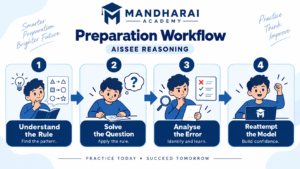
AISSEE Intelligence Test PYQ Analysis: Changing Trends
The analysis indicates several gradual shifts.
1. Alphabet skills have become more important
Recent papers included dictionary order, alphabet positions, word formation and missing-letter sequences. Students should treat alphabet reasoning as a core topic rather than a minor chapter.
2. Analogy now appears in multiple formats
Students may face verbal, numerical, alphabetical or figure analogy. Practising only word relationships will leave a major gap.
3. Visual questions remain regular
Non-verbal reasoning has not disappeared. Mirror images, figure series, embedded figures and figure counting continue to appear.
4. Conventional reasoning still matters
Directions, blood relations, ranking and operators may not appear equally every year, but they remain part of the recurring question pool. The 2026 paper, for example, brought back blood relations and substituted operations.
5. Mixed-rule questions require more attention
Recent questions increasingly combine two or more changes. An alphanumeric analogy may shift the letters and change the number at the same time.
Students must check every component before confirming an answer.
What Question Types Repeat Most Frequently?
Based on their recurrence across the six supplied papers, the topics can be arranged into preparation tiers.
| Preparation tier | Question types | Recommended approach |
|---|---|---|
| Tier 1: Very high priority | Series, analogy, classification and pattern completion | Practise throughout the preparation period |
| Tier 2: High priority | Alphabet test, logical order, dictionary order, coding and number patterns | Complete chapter practice plus weekly revision |
| Tier 3: Regular | Mirror/water images, figure analogy, figure series and embedded figures | Use visual worksheets and timed drills |
| Tier 4: Variable but important | Directions, blood relations, ranking, operators, calendar, dice and Venn diagrams | Learn standard methods and solve PYQ models |
| Tier 5: Supporting | Figure counting, word formation, clock/time-based reasoning | Revise after the core topics are secure |
This is a priority system, not a prediction that low-frequency topics will be absent.
The safest preparation strategy is to master Tier 1 and Tier 2 first, followed by complete coverage of the remaining chapters.
AISSEE Intelligence Test PYQ Analysis: Priority Hierarchy
Students can allocate their Intelligence preparation time in the following way:
- 30%: Number, letter and figure series
- 20%: Verbal, numerical and figure analogy
- 15%: Classification and odd one out
- 15%: Alphabet test, dictionary order and logical sequencing
- 10%: Coding-decoding and mathematical operations
- 10%: Directions, blood relations, ranking and spatial reasoning
These percentages are suggested preparation-time allocations based on the analysed papers. They are not official examination weightages.
The plan gives extra time to series and analogy because these topics appear in several formats and help students develop wider pattern-recognition skills.
Common Mistakes Students Make
1. Memorising answers instead of methods
The examination can change the values while retaining the same logic. Students must understand how the answer is obtained.
2. Assuming the first visible pattern is correct
A number sequence may follow alternating rules. A figure may rotate and change shading simultaneously.
3. Ignoring alphabet positions
Many letter questions become easier after writing A = 1 to Z = 26.
4. Solving mirror images mentally
Students should deliberately check left, right, top and bottom instead of relying only on appearance.
5. Spending too long on one figure
A difficult visual question can consume the time required for several easier verbal questions.
6. Forgetting the changed meanings of symbols
In operation-substitution questions, students sometimes calculate using the original signs.
7. Skipping dictionary-order practice
Children often believe alphabetical order is easy, but similar-looking words create mistakes under time pressure.
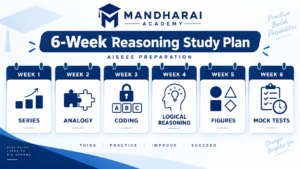
A Six-Week Intelligence Preparation Plan
Week 1: Number and letter series
Practise:
- Fixed-operation series
- Increasing differences
- Alternating series
- Missing-letter sequences
- Alphabet-position patterns
Week 2: Analogy and classification
Cover:
- Word analogy
- Number analogy
- Letter analogy
- Figure analogy
- Odd-one-out questions
Week 3: Coding and alphabet tests
Practise:
- Letter shifting
- Word rearrangement
- Word-to-number coding
- Renaming
- Dictionary order
- Letter positions
- Word formation
Week 4: Logical reasoning
Cover:
- Directions
- Blood relations
- Ranking
- Logical sequence
- Time and calendar
- Mathematical operations
Week 5: Non-verbal reasoning
Practise:
- Mirror images
- Water images
- Figure series
- Figure analogy
- Embedded figures
- Dice
- Figure counting
Week 6: PYQs and timed tests
During the final week:
- Solve the 2021–2026 Intelligence questions again.
- Mark questions that took more than one minute.
- Group mistakes by question type.
- Reattempt incorrect questions without seeing the solution.
- Complete mixed mock tests under time limits.
- Revise shortcuts only after understanding the basic method.
An AISSEE online test series helps students experience mixed question order and develop the habit of moving between verbal, numerical and visual reasoning.
How Mandharai Academy Helps Students Improve
Intelligence cannot be improved through answer memorisation alone. Students need guided exposure to different question models, followed by regular timed practice.
Mandharai Academy’s AISSEE Class 6 Coaching supports students through:
- PYQ-based concept teaching
- Topic-wise Intelligence worksheets
- Easy-to-advanced practice progression
- Weekly tests
- Detailed answer explanations
- Doubt-clearing sessions
- Personal performance feedback
- Full-length mock examinations
- Revision of repeated question models
A student who struggles with coding may need a different explanation from one who loses marks in mirror images. Personal mentoring helps identify these differences early.
This structured approach is especially useful for students seeking AISSEE Online Coaching, Sainik School Online Coaching or an AISSEE coaching programme with mock tests.
A Relatable Student Scenario
Consider two students preparing for AISSEE 2027.
The first student solves random reasoning questions whenever time is available. He completes many easy series but avoids figure reasoning and dictionary order because they feel uncomfortable.
The second student maintains an error notebook. After every test, she records whether the mistake came from misunderstanding the rule, calculating incorrectly or rushing through the options. She reattempts the question after two days and practises three similar models.
After six weeks, the first student may have solved more questions. But the second student has developed a repeatable method for handling unfamiliar questions.
That is the purpose of PYQ analysis. It does not tell students exactly which question will appear. It teaches them which thinking patterns must become automatic.
AISSEE Intelligence Test PYQ Analysis: Final Takeaway
The six-year analysis shows that the AISSEE Intelligence section is broad but structured.
The most dependable areas are:
- Number, letter and figure series
- Verbal, numerical and visual analogy
- Classification and odd one out
- Alphabet tests
- Dictionary and logical order
- Coding-decoding
- Number and figure patterns
- Mirror and water images
- Direction, blood relation and ranking
- Mathematical operations and spatial reasoning
Students should not ask, “Will this exact question repeat?”
They should ask:
“If the examination changes the letters, numbers or figures, can I still identify the rule?”
That ability is what converts PYQ practice into genuine reasoning skill.
For structured AISSEE 2027 exam coaching and Intelligence Test preparation, contact Mandharai Academy:
- Call or WhatsApp: +91 9442455489
- Email: mandharaiacademy@gmail.com
- Instagram: Mandharai Academy
- Facebook: Follow Mandharai Academy
Prepare each question model, track every mistake and practise until the method becomes faster than the doubt.