
AISSEE Language Section Analysis: Grammar, Vocabulary and Comprehension Trends
A student reads English storybooks regularly and speaks confidently in class. Naturally, the parents assume that the AISSEE Language section will be easy.
But during a mock test, the child encounters questions on articles, prepositions, subject-verb agreement, question tags, tenses, collective nouns, idioms, synonyms, antonyms and sentence arrangement. The comprehension passage feels manageable, but several marks are lost in grammar.
This is one of the most common problems in AISSEE Class 6 preparation.
Being able to read or speak English is helpful, but the examination also expects students to understand how the language works. They must recognise grammatical rules, distinguish confusing words, interpret vocabulary in context and answer passage-based questions accurately.
Our AISSEE Language Section Analysis of the English-language papers supplied for 2021 to 2026 shows that the section follows a recognisable structure. Grammar carries the widest range of questions, vocabulary appears consistently, and reading comprehension has become more prominent in recent papers.
Questions on articles, verb forms, tenses, parts of speech, spelling, antonyms, question tags and idioms appeared repeatedly across the six years. This makes them essential preparation areas for AISSEE 2027.
Analysis note: This article examines 150 English Language questions—25 questions from each of the supplied AISSEE Class 6 papers from 2021 to 2026. The AISSEE Language section is based on the language selected by the candidate. Therefore, this analysis specifically studies the supplied English-language papers. Grammar, vocabulary and comprehension categories can overlap because some passage questions also test word meaning or parts of speech.
AISSEE Language Section Analysis: Quick Findings
The six-year analysis produced eight important findings:
- Grammar forms the largest and most varied part of the section.
- Every supplied paper included reading comprehension.
- Passage-based questions increased from three to five from 2023 onwards.
- Articles, verb forms and question tags appeared consistently.
- Spelling, synonyms and antonyms were tested every year.
- Idioms and phrases remained a regular vocabulary area.
- Students are increasingly expected to apply grammar within sentences.
- Questions test accuracy more than advanced literary knowledge.
The section is not designed to test difficult poetry, detailed literary history or lengthy essay writing. Most questions examine whether a Class 5 student can read carefully and apply foundational language rules.
The broad priority order is:
| Priority | Area | PYQ pattern |
|---|---|---|
| Very high | Grammar and correct usage | Largest variety of questions across all six years |
| Very high | Reading comprehension | Present every year; increased to five questions from 2023 |
| High | Synonyms, antonyms and word meanings | Appeared consistently |
| High | Spelling and confusing words | Present throughout the analysed period |
| High | Idioms and phrases | Appeared across all six papers |
| Medium to high | Sentence arrangement and correction | Recurring but not equally represented every year |
| Medium | Collective nouns, gender and plural forms | Frequently tested in selected years |
| Medium | Figures of speech and advanced usage | Appeared selectively, including in 2026 |
How the Six Papers Were Analysed
The 25 English Language questions from each paper were classified under three main areas:
- Grammar
- Vocabulary
- Reading comprehension
The questions were then organised into smaller subtopics such as:
- Articles
- Prepositions
- Tenses
- Verb forms
- Subject-verb agreement
- Pronouns
- Nouns
- Adjectives
- Adverbs
- Conjunctions
- Question tags
- Sentence types
- Degree of comparison
- Gender and number
- Sentence arrangement
- Sentence correction
- Synonyms
- Antonyms
- Spellings
- Homophones and confusing words
- Idioms and phrases
- Occupation-based vocabulary
- Passage facts
- Passage inference
- Contextual word meaning
- Parts of speech within passages
Students should use this trend analysis together with the current AISSEE Class 6 syllabus. Latest application details and official examination notices should always be checked through the NTA AISSEE portal and the Sainik Schools Society.
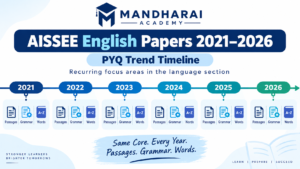
AISSEE Language Section Analysis: Year-Wise Trends
Although every paper contained 25 Language questions, the distribution and placement of comprehension questions changed.
| Year | Passage questions | Important areas observed |
|---|---|---|
| 2021 | 3 | Prepositions, articles, sentence arrangement, nouns, pronouns, question tags, verbs, vocabulary and idioms |
| 2022 | 3 | Articles, prepositions, rearrangement, pronouns, verbs, spelling, adjectives, antonyms and conjunctions |
| 2023 | 5 | Parts of speech, noun types, question tags, verb forms, pronouns, articles, prepositions, idioms and homophones |
| 2024 | 5 | Tenses, subject-verb agreement, degree of comparison, sentence correction, conjunctions, articles, idioms and spelling |
| 2025 | 5 | Collective nouns, gender, plural forms, comparison, idioms, pronouns, articles, verb forms and confusing words |
| 2026 | 5 | Prepositions, passage grammar, synonyms, idioms, tenses, comparison, figures of speech, verbs and question tags |
The six papers contained 26 passage-linked questions in total:
- Three in 2021
- Three in 2022
- Five in 2023
- Five in 2024
- Five in 2025
- Five in 2026
Some of these questions tested direct comprehension, while others used the passage to ask about vocabulary or parts of speech.
The overall trend suggests that students should prepare grammar, vocabulary and comprehension together rather than treating them as completely separate subjects.
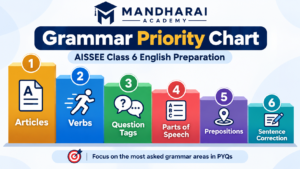
Grammar Trends: The Largest Preparation Area
Grammar remains the broadest part of the AISSEE Language section. However, the questions are generally application-based.
A student may not be asked to write the definition of a pronoun. Instead, the student must select the correct pronoun for a sentence. Similarly, a tense question may require the correct verb form rather than the name of the tense.
The most frequently recurring grammar areas were:
- Articles
- Verb forms and tenses
- Parts of speech
- Question tags
- Nouns and pronouns
- Adjectives and degrees of comparison
- Prepositions
- Subject-verb agreement
- Sentence arrangement
- Sentence types
- Conjunctions
- Singular and plural forms
Articles appeared every year
Questions on a, an and the appeared consistently in the supplied papers.
Examples of the tested rules included:
- Using “an” before a vowel sound
- Using “the” for a particular person, place or object
- Choosing articles based on the complete noun phrase
- Recognising when no article is required
- Filling two article blanks within the same sentence
Students should remember that articles depend on sound, not simply the first written letter.
For example:
- an honest officer
- a university student
- an intelligent child
- the Sun
- a silver lining
“Honest” begins with the consonant letter h, but the “h” is silent, so the word begins with a vowel sound.
Verbs and tenses appeared every year
The papers repeatedly tested:
- Simple present
- Simple past
- Present continuous
- Past continuous
- Present perfect
- Past perfect
- Present perfect continuous
- Conditional verb forms
- Agreement between subject and verb
Examples included selecting forms such as:
- “The Sun sets in the West.”
- “The train stopped suddenly.”
- “While I was writing a letter, my teacher came.”
- “You have been working very hard.”
- “If I were a doctor…”
The 2026 paper used more specific tense identification and conditional grammar, indicating that students should understand why a verb form is correct instead of memorising isolated examples.
Question tags are extremely important
Question tags appeared in all six supplied papers.
The examination tested sentences such as:
- Positive statement followed by a negative tag
- Negative statement followed by a positive tag
- Tags with auxiliary verbs
- Tags with special words such as “everything”
- Sentences beginning with “there”
- Modal-based tags
The basic rule is:
- Positive statement → negative question tag
- Negative statement → positive question tag
Examples:
- She sings well, doesn’t she?
- He works in a school, doesn’t he?
- Everything is fine, isn’t it?
- There is no doubt, is there?
Students must also identify the correct auxiliary verb and pronoun.
Parts of Speech and Sentence Usage
Parts of speech appeared through both direct and passage-based questions.
The papers tested:
- Nouns
- Pronouns
- Adjectives
- Adverbs
- Verbs
- Conjunctions
- Prepositions
- Interjections
Examples included identifying:
- “Technology” as a noun
- “Hair” as a noun
- “High” as an adjective
- “Soon” or “later” as an adverb
- “Bravo!” as an interjection
- A suitable conjunction joining two parts of a sentence
Students should not prepare parts of speech as definitions alone.
They should practise identifying the job performed by a word inside a sentence. The same word can sometimes act as different parts of speech depending on its use.
For example:
- It was a fast car. — Adjective
- He ran fast. — Adverb
Nouns, gender and plurals
Questions included:
- Common nouns
- Abstract nouns
- Collective nouns
- Gender forms
- Regular and irregular plurals
Collective nouns tested groups such as:
- A troop of soldiers
- A fleet of ships
- A bouquet of flowers
- A group of thieves
Plural questions included irregular forms such as:
- Mouse → Mice
- Woman → Women
- Child → Children
- Sheep → Sheep
- Formula → Formulae or formulas
The examination often places one incorrect pair among three familiar correct pairs. Students must inspect every option rather than choosing the first one that appears reasonable.
AISSEE Language Section Analysis: Vocabulary Trends
Vocabulary was tested every year through several different formats.
The most common models were:
- Synonyms
- Antonyms
- Contextual meanings
- Correct spelling
- Idioms and phrases
- Homophones
- Occupation-based vocabulary
- Choosing the most suitable word
- Prefix-based opposites
- Meaning of words taken from a passage
Vocabulary questions do not always ask, “Choose the synonym.” A word may be placed within a sentence, and the student must choose the meaning that fits the context.
Synonyms and antonyms
Frequently tested word relationships included:
- Important as a synonym of momentous
- Very big as the meaning of gigantic
- Receive as the opposite of send
- Coward as the opposite of brave
- Thin as the opposite of thick
- Imaginary as the opposite of real
- Revenge as the opposite of forgiveness
- Erect as the opposite of demolish
- Death as the meaning of demise
Students should learn a word with its related forms.
For example:
| Word | Synonym | Antonym | Related form |
|---|---|---|---|
| Brave | Courageous | Cowardly | Bravery |
| Demolish | Destroy | Construct | Demolition |
| Gigantic | Enormous | Tiny | Gigantic size |
| Recognise | Identify | Ignore | Recognition |
| Accessible | Reachable | Inaccessible | Access |
Learning vocabulary in connected groups improves retention.
Spellings appeared every year
Correct-spelling questions included words such as:
- Apartment
- Appointment
- Sincerity
- Receive
- Separate
- Biscuit
The distractors were often based on:
- Doubled or missing letters
- Reversed vowel combinations
- Incorrect suffixes
- Confusion between “ie” and “ei”
- Spellings based on pronunciation
Students should keep a personal spelling notebook and divide it into:
- Frequently misspelt words
- Double-letter words
- “ie” and “ei” words
- Silent-letter words
- Words with common suffixes
- Words found in PYQs
Confusing words and homophones
The papers included word sets such as:
- Accept and except
- There, their and they’re
- Weather and whether
- Decent, descent and dissent
- Soar, sore, sour and sure
- Cease, seize and sees
These questions cannot be solved through pronunciation alone. The child must understand each word’s meaning and its role in the sentence.
For example:
- Their car is parked over there.
- I do not know whether the weather will improve.
- The army seized the fort.
- Please accept the gift from everyone except Rahul.
Idioms and Phrases Are a Consistent Area
Idioms appeared in different forms across all six papers.
Examples included:
- Beat around the bush
- Birds of a feather flock together
- Hit the nail on the head
- Beat the air
- Raining cats and dogs
- Live in an ivory tower
- One’s cup of tea
Students should not interpret idioms literally.
For instance:
- “Raining cats and dogs” means raining heavily.
- “Hit the nail on the head” means identify or say exactly what is correct.
- “Beat around the bush” means avoid discussing the main point.
- “One’s cup of tea” means something a person likes or is suited to.
- “Beat the air” means make useless efforts.
- “Live in an ivory tower” means remain separated from practical reality.
A useful activity is to ask the student to use each idiom in a new sentence. This tests genuine understanding.
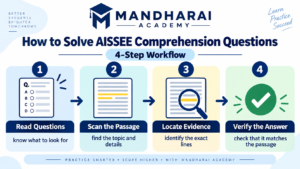
Comprehension Trends from 2021 to 2026
Reading comprehension appeared in every supplied paper.
The passages covered child-friendly informational or narrative topics, including:
- Zeus and Prometheus
- The Seven Wonders of the Ancient World
- The history of postage stamps
- Pashmina shawls
- The art of conversation
- Dr A.P.J. Abdul Kalam
The topics combined reading practice with history, culture, science, mythology and general awareness.
Comprehension questions tested:
- Direct factual information
- Correct and incorrect statements
- Main idea
- Meaning of a word in context
- Synonyms and antonyms
- Parts of speech
- Applying a passage word in a new sentence
Direct questions versus inference questions
Most questions could be answered using information stated directly in the passage.
However, students still lost marks because they:
- Answered from memory instead of the passage
- Missed negative words such as “not” or “incorrect”
- Chose an option that was generally true but unsupported by the text
- Confused two similar names or details
- Read only the first half of the passage
The correct approach is:
- Read the questions quickly.
- Read the passage carefully.
- Underline names, numbers, places and important facts.
- Return to the exact sentence supporting each answer.
- Check negative wording before marking the option.
Passage weight increased after 2022
The 2021 and 2022 papers contained three passage-linked questions each. From 2023 to 2026, the supplied papers contained five each.
This suggests that comprehension should receive regular preparation time. A student who avoids passages may risk losing a meaningful share of the section.
AISSEE Language Section Analysis: Recurring Question Types
The strongest recurring patterns are summarised below.
| Question type | Recurrence in supplied papers | Preparation priority |
|---|---|---|
| Reading comprehension | All six years | Very high |
| Articles | All six years | Very high |
| Verbs and tenses | All six years | Very high |
| Question tags | All six years | Very high |
| Parts of speech | All six years | Very high |
| Spelling | All six years | High |
| Synonyms and antonyms | All six years | High |
| Idioms and phrases | All six years | High |
| Prepositions | Most years | High |
| Nouns, pronouns and plurals | Several years | High |
| Sentence arrangement | More prominent in 2021–2023 and 2025 | Medium |
| Homophones and confusing words | Several years | Medium to high |
| Figures of speech | Selective; visible in 2026 | Supporting topic |
The safest preparation plan is to master the first eight areas before spending too much time on rare grammar terminology.
Common Mistakes Students Make
1. Selecting an answer that merely sounds correct
Grammar questions are designed with options that sound similar. Students must apply a rule.
2. Ignoring the subject of the sentence
A plural-looking word near the verb may not be the subject.
For example:
The quality of these products is good.
“Quality” is the subject, not “products.”
3. Reading idioms literally
An idiom’s actual meaning may be completely different from its individual words.
4. Guessing spellings from pronunciation
English spelling does not always follow pronunciation. Repeated written practice is necessary.
5. Rushing through negative questions
Words such as not, incorrect, opposite and except change the entire question.
6. Using general knowledge in comprehension
The answer must come from the passage, even if the student knows additional facts about the subject.
7. Memorising grammar definitions without application
A child may define an adverb correctly but fail to identify it within a sentence.
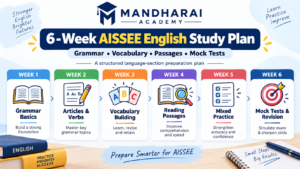
A Six-Week Language Preparation Plan
Week 1: Parts of speech
Cover:
- Nouns
- Pronouns
- Adjectives
- Adverbs
- Verbs
- Prepositions
- Conjunctions
- Interjections
Practise identifying each word inside a complete sentence.
Week 2: Articles, verbs and agreement
Cover:
- A, an and the
- Present and past forms
- Continuous and perfect tenses
- Subject-verb agreement
- Conditional sentences
- Correct verb selection
Week 3: Sentence grammar
Cover:
- Question tags
- Sentence types
- Degrees of comparison
- Gender
- Singular and plural
- Sentence correction
- Jumbled sentences
Week 4: Vocabulary
Cover:
- Synonyms
- Antonyms
- Spellings
- Homophones
- Contextual meanings
- Occupation words
- Commonly confused words
Week 5: Idioms and comprehension
Complete:
- Five idioms each day
- One short passage daily
- Main-idea questions
- True or false statements
- Contextual vocabulary
- Parts of speech from passages
Week 6: PYQs and timed practice
During the final week:
- Reattempt the 2021–2026 Language questions.
- Maintain a grammar-error notebook.
- Revise incorrectly spelt words.
- Complete mixed Language tests.
- Practise one timed passage daily.
- Reattempt every wrong answer after two days.
An AISSEE online test series can help students identify whether they are losing marks in grammar knowledge, vocabulary recall, comprehension or time management.
A Relatable Student Scenario
Consider two students preparing for the Language section.
The first student reads the grammar rules repeatedly. She can recite the definitions of nouns, verbs and adjectives but completes very few practice questions.
The second student studies one rule and immediately solves ten application-based questions. Every wrong answer is written in an error notebook with the corrected sentence. She also reads one short passage each day and explains its main idea aloud.
After six weeks, the second student is likely to perform better—not because she memorised more definitions, but because she learnt to apply the rules under examination conditions.
That is the central lesson from the PYQs: AISSEE rewards practical language use.
How Mandharai Academy Supports Language Preparation
Mandharai Academy’s AISSEE Class 6 Coaching helps students develop grammar accuracy, vocabulary and reading ability through:
- Concept-based English classes
- PYQ-model grammar exercises
- Weekly vocabulary revision
- Spelling and confusing-word practice
- Guided reading comprehension
- Timed Language tests
- Detailed answer explanations
- Doubt-clearing sessions
- Personal performance feedback
- Full-length AISSEE mock examinations
The aim is not simply to teach rules. Students learn how to recognise the rule hidden inside a question and eliminate incorrect options.
This structured approach is useful for parents searching for AISSEE Online Coaching, Sainik School Online Coaching, AISSEE English Coaching or an AISSEE coaching programme with mock tests and personal mentoring.
AISSEE Language Section Analysis: Final Takeaway
The six-year PYQ analysis shows that the Language section is broad but highly preparable.
The most important areas are:
- Reading comprehension
- Articles and prepositions
- Verb forms and tenses
- Subject-verb agreement
- Question tags
- Parts of speech
- Nouns, pronouns and plurals
- Degrees of comparison
- Synonyms and antonyms
- Correct spelling
- Idioms and phrases
- Confusing words
- Sentence arrangement and correction
The strongest strategy is simple:
Learn the rule, apply it in a sentence, analyse the mistake and revise it through a new question.
For structured AISSEE 2027 exam coaching and Language preparation, contact Mandharai Academy:
- Call or WhatsApp: +91 9442455489
- Email: mandharaiacademy@gmail.com
- Instagram: Mandharai Academy
- Facebook: Follow Mandharai Academy
Build accuracy before speed, practise a little every day and let the previous-year questions guide your preparation.