

How to Avoid Silly Mistakes in the AISSEE Examination: Practical Exam Tips
A student returns from an AISSEE mock test and says, “I knew the answer, but I marked the wrong option.”
Another student solves a Mathematics question correctly on the rough sheet but transfers the wrong option to the OMR sheet. Someone else finds the area when the question asks for the perimeter. A well-prepared child loses a comprehension mark because the word “incorrect” was overlooked.
These are commonly called silly mistakes. However, most of them are not random. They usually happen because of rushing, weak checking habits, poor time management, unclear rough work or anxiety.
Learning how to avoid silly mistakes in the AISSEE examination can improve a student’s score without requiring the child to learn an entirely new chapter.
AISSEE tests more than subject knowledge. Students must move between Mathematics, Language, Intelligence and General Knowledge while maintaining concentration. They need to read carefully, calculate accurately, manage time and mark answers correctly.
The good news is that careless mistakes can be reduced through a practical system.
Key idea: “Be careful” is not an exam strategy. Students need specific actions that make errors less likely.
Why Students Make Silly Mistakes in AISSEE
A silly mistake is usually an error made even though the student knows the concept.
Common examples include:
- Reading “incorrect” as “correct”
- Adding instead of subtracting
- Using HCF when LCM is required
- Forgetting to convert minutes into hours
- Misaligning decimal points
- Selecting an option before completing the calculation
- Confusing mirror images with water images
- Marking the answer against the wrong question number
- Changing a correct answer without a valid reason
- Spending too long on one difficult question
- Leaving an easy question unanswered
These errors usually come from one or more of the following causes:
| Cause | How it affects performance |
|---|---|
| Rushing | Important words, signs and units are missed |
| Anxiety | The student forgets familiar methods |
| Poor time management | The final questions are attempted hurriedly |
| Untidy rough work | Steps and answers become difficult to track |
| Weak reading habits | The child answers a different question |
| Inadequate mock practice | The exam format feels unfamiliar |
| Overconfidence | Easy questions are not checked |
| Excessive doubt | Correct answers are changed unnecessarily |
| Weak OMR habits | The selected option and marked bubble do not match |
The solution is not simply to tell children to concentrate. Concentration improves when they follow a repeatable process.
Avoid Silly Mistakes in the AISSEE Examination with the Five-Second Rule
Before solving each question, students should pause briefly and identify five things:
- Command word: What is the question asking?
- Given information: Which facts or numbers are provided?
- Required answer: What must be found?
- Unit or category: Is the answer in centimetres, rupees, minutes, percentages or words?
- Special condition: Does the question contain “not,” “incorrect,” “except,” “least” or “greatest”?
This pause does not need to take exactly five seconds. Its purpose is to stop the student from reacting before understanding.
Important command words can be lightly underlined in the question booklet, if permitted:
- Correct
- Incorrect
- Not
- Except
- Greatest
- Smallest
- Difference
- Remaining
- Total
- Maximum
- Minimum
- Ascending
- Descending
A single missed word can change the entire answer.
For example:
Which of the following is not an equivalent fraction?
A student who overlooks “not” may select the first equivalent fraction and lose an avoidable mark.

Understand the Seven Main Types of AISSEE Errors
Students should classify mistakes instead of writing only the correct answer.
1. Reading errors
The student misunderstands the instruction, misses a keyword or skips part of a sentence.
Prevention: Read the final line of a word problem twice before calculating.
2. Concept errors
The child uses the wrong method, formula or grammatical rule.
Prevention: Revisit the chapter and solve three similar questions.
3. Calculation errors
The method is correct, but an arithmetic mistake changes the answer.
Prevention: Estimate the result and check the critical operation.
4. Unit errors
The child mixes centimetres and metres, grams and kilograms, or minutes and hours.
Prevention: Write the unit beside every important value.
5. Option errors
The answer is calculated correctly, but a different option is selected.
Prevention: Circle the final value on the rough sheet and match it with the option.
6. OMR errors
The correct option is selected in the booklet but marked against the wrong question number.
Prevention: Check the question number immediately before shading.
7. Time-management errors
The student spends too long on a difficult question and rushes through easier ones.
Prevention: Use a planned multi-pass strategy.
Mathematics Mistakes and How to Prevent Them
Mathematics produces some of the most frustrating mistakes because a single incorrect sign or digit can spoil an otherwise correct solution.
Common AISSEE Mathematics errors include:
- Confusing HCF and LCM
- Forgetting BODMAS
- Misaligning decimals
- Using the wrong denominator
- Failing to simplify fractions
- Mixing area, perimeter and volume
- Forgetting unit conversion
- Finding simple interest instead of the total amount
- Using selling price instead of cost price as the percentage base
- Copying a number incorrectly from the question
- Dropping a zero during multiplication or division
Use the Formula–Substitute–Calculate–Check method
For formula-based questions, use four steps:
- Write the formula.
- Substitute the given values.
- Calculate.
- Check the unit and reasonableness.
For example:
[
\text{Area of rectangle}=l\times b
]
If (l=12\text{ cm}) and (b=8\text{ cm}):
[
12\times8=96\text{ cm}^2
]
The square unit confirms that the answer represents area.
Estimate before selecting the option
If the calculation is approximately:
[
49\times21
]
Estimate:
[
50\times20=1000
]
The exact answer should be near 1,000. An answer such as 10,290 should immediately appear suspicious.
Align decimal points
When adding or subtracting decimals, write:
  6.7850
- 2.4624
Do not align numbers based on their final digit.
Write units during the calculation
Instead of converting everything only at the end, write:
[
2\text{ m}=200\text{ cm}
]
This prevents the child from combining incompatible units.
Avoid Silly Mistakes in the AISSEE Examination Language Section
Language errors often occur because students choose an option that “sounds right” without checking the grammar rule.
Common mistakes include:
- Missing “not true” in a passage question
- Answering from memory instead of the passage
- Confusing a, an and the
- Choosing a verb that does not agree with the subject
- Using the wrong question tag
- Confusing there, their and they’re
- Selecting a synonym that does not fit the context
- Reading an idiom literally
- Overlooking tense clues such as yesterday, since or while
Use passage evidence
For comprehension, every answer should be supported by a line or idea in the passage.
Students should:
- Read the questions quickly.
- Read the passage carefully.
- Underline names, places, dates and key ideas.
- Return to the relevant sentence.
- Check whether the question asks for a correct or incorrect statement.
Do not select an option simply because it is generally true. It must agree with the passage.
Identify the grammar clue
Before choosing an answer, ask:
- What is the subject?
- Is it singular or plural?
- What is the tense?
- Is the blank followed by a noun or verb?
- Does the word begin with a vowel sound?
- Is a comparison being made?
- Is the statement positive or negative?
For example:
He works in school, ______?
The statement is positive and uses the present tense. Therefore, the tag should be negative:
He works in school, doesn’t he?
Intelligence-Test Mistakes and Their Solutions
Intelligence questions can appear simple, causing students to answer too quickly.
Common errors include:
- Applying a pattern to only the first two terms
- Missing an alternating series
- Checking letters but ignoring numbers in an alphanumeric analogy
- Reversing left and right incorrectly
- Confusing a mirror image with a water image
- Misreading blood relations
- Counting one figure twice
- Forgetting changed meanings of mathematical symbols
- Arranging words by only their first letter
Verify the rule with more than one term
In a series, a possible rule should work throughout the sequence.
If the student identifies a difference between the first two numbers, that same method must be checked against the next terms.
Convert letters into positions
For difficult letter patterns, write:
[
A=1,\ B=2,\ C=3,\ldots,Z=26
]
This is safer than guessing visually.
Draw blood relations
For family-relation questions, use short symbols:
- Male: M
- Female: F
- Parent: vertical line
- Sibling: horizontal connection
A small diagram can prevent confusion.
Remember the visual difference
- Mirror image: Normally reverses left and right.
- Water image: Normally reverses top and bottom.
Check the position of:
- Dots
- Arrows
- Open sides
- Shading
- Letters
- Internal shapes
GK Mistakes and How to Control Them
Students frequently lose GK marks by overthinking a familiar fact.
Common mistakes include:
- Confusing similar names
- Selecting a related but incorrect place
- Mixing a personality with another achievement
- Forgetting whether the question asks for a state or city
- Ignoring “not” or “incorrect”
- Changing the first correct answer without evidence
- Applying current information to a static-GK question
A useful GK method is:
- Read the complete question.
- Eliminate clearly incorrect options.
- Match the exact relationship.
- Avoid inventing additional conditions.
- Reconsider the answer only if a specific fact was recalled.
For example, if the question asks where Golconda Fort is located, do not become distracted by options containing other famous monuments. Match the exact monument-city relationship.

Use the Three-Pass Examination Strategy
A structured attempt order can reduce panic and protect easy marks.
First pass: Direct and familiar questions
Attempt questions that:
- Have an immediately recognisable method
- Require little calculation
- Test a known fact
- Can be solved confidently
Second pass: Moderate questions
Return to questions involving:
- Two or three calculation steps
- Detailed passages
- Alphabet or number patterns
- Closely related options
- Unit conversions
Third pass: Difficult or uncertain questions
Finally attempt:
- Lengthy word problems
- Complex figures
- Questions requiring repeated checking
- Items where two options still appear possible
This approach prevents a difficult question from consuming the time available for several easy ones.
Students should decide their time allocation during mock tests and adjust it according to their strengths.

Avoid Silly Mistakes in the AISSEE Examination OMR Sheet
OMR mistakes can cancel out correct subject knowledge. Students should practise OMR marking before the actual examination.
Follow the current information bulletin, admit card and invigilator’s instructions regarding the permitted pen and marking procedure.
A safe OMR routine is:
- Confirm the question number.
- Confirm the selected option.
- Locate the same number on the OMR sheet.
- Shade the corresponding bubble completely.
- Return to the next question without shifting the sequence.
Students should avoid:
- Partial shading
- Ticks or crosses instead of full bubbles
- Stray marks
- Marking between two options
- Using an unapproved writing instrument
- Folding or damaging the sheet
- Shading an answer against the wrong question number
- Making corrections contrary to the official instructions
The official NTA AISSEE portal provides current notices and an OMR guidance link. Students should also check the Sainik Schools Society website for official admission information.
One-by-one or small-batch marking?
Students should test both methods during mocks:
- Marking each answer immediately
- Marking a small group of completed questions together
The safest method is the one that gives the student fewer numbering errors. Large-batch transfer at the end is risky because time pressure can cause an entire sequence to shift.
Create Clean and Traceable Rough Work
Untidy rough work is a major source of errors.
Use these habits:
- Start each calculation with the question number.
- Keep one question’s work in one area.
- Do not write over an earlier calculation.
- Circle the final result.
- Cross out abandoned methods clearly.
- Write important units.
- Keep diagrams simple but labelled.
- Do not rely on calculations written in the question margin without numbering.
For example:
Q42
CP = ₹800
Profit = 15% of ₹800 = ₹120
SP = ₹920
Answer: Option C
This makes the work easy to verify.
When Should a Student Change an Answer?
Changing an answer is not always wrong. Changing it without evidence is dangerous.
A student should change an answer only if:
- A calculation error is found.
- A keyword was missed.
- A formula was used incorrectly.
- A passage line clearly supports another option.
- An OMR-option mismatch is identified.
- A remembered fact can be verified confidently.
Do not change an answer merely because:
- The same option appeared several times.
- A nearby student finished earlier.
- The option seems “too easy.”
- Nervousness creates doubt.
- Another option suddenly looks familiar.
The second guess is not automatically better than the first one.
Reserve a Final Checking Window
Students should aim to preserve approximately 10–15 minutes for a structured final review, depending on the strategy tested during mocks.
Do not use this time to resolve only one difficult question.
Check in the following order:
- Unanswered questions
- OMR question-number sequence
- Questions containing “not,” “incorrect” or “except”
- Units and decimal points
- Mathematics formulas
- Passage-based answers
- Questions where the option was changed
- Stray or unclear OMR markings
This order prioritises errors that can be corrected quickly.
Build an AISSEE Mistake Tracker
After every mock test, record each lost mark.
| Question | Subject | Error type | Why it happened | Prevention rule |
|---|---|---|---|---|
| 12 | Maths | Unit error | Metres not converted | Write all units before calculating |
| 39 | Language | Reading error | Missed “incorrect” | Underline negative words |
| 68 | Intelligence | Pattern error | Checked one gap only | Verify rule across all terms |
| 91 | GK | Option error | Confused city and state | Identify what category is asked |
| 104 | OMR | Transfer error | Marked Q105 bubble | Confirm number before shading |
Review the tracker weekly.
If the same mistake appears three times, it is no longer a silly mistake—it is a habit that needs focused correction.
Avoid Silly Mistakes in the AISSEE Examination Through Mock Tests
A mock test should train exam behaviour, not only measure knowledge.
Every full mock should reproduce:
- The expected time limit
- Mixed subject order
- OMR marking
- Limited breaks
- Rough-work discipline
- Planned question selection
- Final checking
After the mock, calculate:
- Accuracy percentage
- Number of unattempted questions
- Questions changed from correct to incorrect
- OMR errors
- Calculation errors
- Reading errors
- Time spent on each section
An AISSEE online test series can help students become familiar with full-paper pressure and recognise recurring error patterns before the final examination.
Students should also revise the latest AISSEE Class 6 syllabus so that mock preparation remains aligned with the required topics.
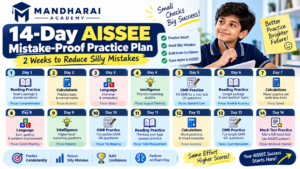
A 14-Day Anti-Mistake Training Plan
Days 1–2: Diagnose mistakes
- Complete one mixed test.
- Classify every incorrect answer.
- Identify the three most frequent error types.
Days 3–4: Reading discipline
- Underline command words.
- Practise “correct/incorrect” questions.
- Read word problems twice before solving.
Days 5–6: Calculation control
- Align decimals.
- Check units.
- Estimate answers.
- Practise BODMAS and fraction simplification.
Days 7–8: Language and comprehension
- Complete one passage daily.
- Identify grammar clues.
- Revise question tags, articles and confusing words.
Days 9–10: Intelligence and GK
- Verify patterns across all terms.
- Draw direction and family diagrams.
- Practise eliminating GK options.
Days 11–12: OMR practice
- Complete a sectional test using an OMR sheet.
- Check question-option mapping.
- Review marking discipline.
Day 13: Full mock
- Follow the three-pass strategy.
- Reserve a checking window.
- Record all mistakes.
Day 14: Final correction
- Reattempt every incorrect question.
- Write one prevention rule for each error.
- Create a personal exam-day checklist.
A Relatable Student Scenario
Imagine two equally prepared students entering an AISSEE mock test.
The first student begins quickly and attempts every question in sequence. A difficult Mathematics problem consumes several minutes. The student rushes later, misses “not” in a Language question and shifts one OMR answer.
The second student uses a three-pass plan. Difficult questions are marked for later. Negative words are underlined. Every rough calculation is numbered, and the OMR sequence is checked periodically. The final ten minutes are used to review unanswered questions and units.
The second student may not know more content. However, the student has a better examination system.
That difference can protect several marks.
How Parents Can Help
Parents can reduce mistakes without increasing anxiety.
Helpful actions include:
- Conducting one timed mock each week
- Asking the child to explain why an error occurred
- Maintaining a calm testing environment
- Checking the error tracker
- Praising improved accuracy
- Avoiding comparisons with other students
- Practising OMR sheets
- Ensuring proper sleep before tests
Avoid repeatedly saying:
- “Don’t make silly mistakes.”
- “Why are you so careless?”
- “You knew this answer.”
- “Other students finish faster.”
Instead ask:
- Which step caused the mistake?
- What reminder can prevent it next time?
- Did you check the unit?
- Which questions should have been attempted first?

Exam-Day Practical Checklist
Before leaving home, confirm:
- Admit card
- Required identification
- Permitted writing materials
- Examination-centre details
- Reporting time
- Water or other permitted items
- Any instructions mentioned in the admit card
Inside the examination hall:
- Listen to the invigilator.
- Read the booklet instructions.
- Check the booklet and OMR details.
- Write required information carefully.
- Begin with a calm breathing rhythm.
- Follow the planned attempt order.
- Do not watch how quickly others finish.
- Preserve time for final checking.
Students should always follow the latest official instructions rather than depending on an older examination routine.
Avoid Silly Mistakes in the AISSEE Examination: Final Takeaway
Students do not eliminate mistakes by trying to become perfect. They reduce mistakes by building dependable habits.
Before each answer:
- Read the command word.
- Identify what must be found.
- Check the unit.
- Use a clear method.
- Match the result with the option.
- Confirm the question number before marking.
During the paper:
- Attempt familiar questions first.
- Avoid getting trapped by one difficult question.
- Keep rough work organised.
- Follow official OMR instructions.
- Reserve time for checking.
After every mock:
- Classify each mistake.
- Write a prevention rule.
- Reattempt the question.
- Track whether the error returns.
Mandharai Academy’s AISSEE Class 6 Coaching supports students through concept teaching, PYQ-based practice, calculation drills, OMR practice, weekly tests, full-length mocks, doubt clearing and personal feedback.
For structured AISSEE 2027 exam coaching and training, contact us:
- Call or WhatsApp: +91 9442455489
- Email: mandharaiacademy@gmail.com
- Instagram: Mandharai Academy
- Facebook: Follow Mandharai Academy
Preparation builds knowledge. A strong examination system protects the marks earned through that preparation.