
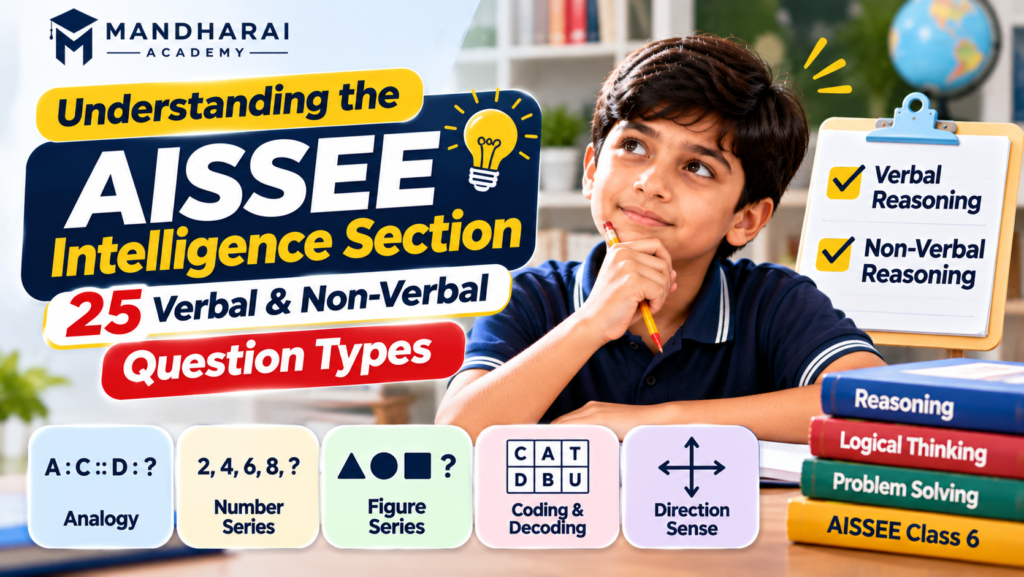
Understanding the AISSEE Intelligence Section: 25 Verbal & Non-Verbal Question Types
The Intelligence section is an important part of the All India Sainik Schools Entrance Examination (AISSEE) for Class 6. Unlike Mathematics and Language, this section mainly tests a student’s ability to identify patterns, understand relationships, think logically and solve problems.
In the AISSEE 2026 examination pattern, the Intelligence section contained 25 questions carrying 50 marks. Each correct answer carried 2 marks.
Students do not need advanced mathematical knowledge to approach most reasoning questions. Instead, they need observation skills, logical thinking, concentration and regular practice.
The official AISSEE syllabus mentions broad areas such as analogies, spatial and mathematical patterns, classification, visual and logical reasoning, series and sequences, critical thinking, problem-solving and familial relations.
In this guide, we will explore 25 useful verbal and non-verbal reasoning question formats to help students understand the types of practice they can include in their AISSEE preparation.
What Is the Intelligence Section in AISSEE?
The Intelligence section evaluates how effectively students can understand information and identify relationships between objects, words, numbers and figures.
It generally includes two broad styles of reasoning:
Verbal Reasoning: Questions based on words, numbers, relationships, sequences and logical statements.
Non-Verbal Reasoning: Questions based on pictures, shapes, figures, symbols, patterns and visual arrangements.
Both types help develop observation, analytical thinking and problem-solving abilities.
Part 1: Verbal Reasoning – 12 Important Question Formats
Verbal reasoning questions use words, numbers and logical relationships. Students need to understand the information and identify the correct answer.
1. Word Analogy
Word analogy questions test the relationship between two words.
Example:
Bird : Fly :: Fish : ?
A) Walk
B) Swim
C) Run
D) Jump
Answer: B) Swim
Explanation: A bird flies, while a fish swims.
2. Number Analogy
Students identify the mathematical relationship between two numbers and apply it to another pair.
Example:
4 : 8 :: 6 : ?
A) 10
B) 12
C) 14
D) 16
Answer: B) 12
Explanation: The second number is double the first number.
3. Alphabet Analogy
These questions test relationships between letters of the English alphabet.
Example:
A : C :: D : ?
A) E
B) F
C) G
D) H
Answer: B) F
Explanation: Two letters forward in the alphabet.
4. Number Series
Students identify the missing number in a sequence by finding the pattern.
Example:
2, 4, 6, 8, ?
A) 9
B) 10
C) 12
D) 14
Answer: B) 10
Explanation: Each number increases by 2.
5. Alphabet Series
These questions involve a sequence of letters arranged according to a particular rule.
Example:
A, C, E, G, ?
A) H
B) I
C) J
D) K
Answer: B) I
Explanation: One letter is skipped each time.
6. Odd One Out – Words
Students identify the word that does not belong to a particular group.
Example:
A) Apple
B) Mango
C) Banana
D) Carrot
Answer: D) Carrot
Explanation: The other three are fruits, while carrot is a vegetable.
7. Odd One Out – Numbers
Students identify a number that does not follow the same mathematical property as the others.
Example:
A) 4
B) 9
C) 16
D) 18
Answer: D) 18
Explanation: The first three are perfect squares.
8. Classification
Classification questions ask students to group words, numbers or objects according to their common characteristics.
Example:
Which group contains only even numbers?
A) 2, 4, 6
B) 3, 5, 7
C) 1, 4, 7
D) 2, 5, 8
Answer: A) 2, 4, 6
9. Coding and Decoding
Students identify how letters or numbers are changed according to a particular code.
Example:
If CAT is written as DBU, how is DOG written?
A) EPH
B) EOG
C) FPH
D) DPH
Answer: A) EPH
Explanation: Each letter is replaced by the next letter in the alphabet.
10. Blood Relations and Family Relations
These questions test the student’s understanding of family relationships.
Example:
Ravi is the son of Meena. Meena is the sister of Kumar. How is Kumar related to Ravi?
A) Father
B) Uncle
C) Brother
D) Grandfather
Answer: B) Uncle
11. Direction Sense
Students identify directions and determine the final position of a person or object.
Example:
A boy walks 5 metres towards the north and then turns right. Which direction is he facing?
A) South
B) East
C) West
D) North
Answer: B) East
12. Logical Problem-Solving
These questions require students to understand a situation and select the answer that follows logically.
Example:
All roses are flowers. Which statement is correct?
A) All flowers are roses.
B) All roses are flowers.
C) No roses are flowers.
D) All flowers are trees.
Answer: B) All roses are flowers.
Part 2: Non-Verbal Reasoning – 13 Important Question Formats
Non-verbal reasoning questions use shapes, diagrams, figures and visual patterns. Students need to observe the given figures carefully and identify the relationship or missing part.
13. Figure Analogy
Students identify the relationship between two figures and apply the same relationship to another figure.
Example:
If a small circle changes into a large circle, what should a small square change into?
Answer: A large square.
14. Figure Classification
Students identify the figure that does not belong to a group.
Example:
Four figures are shown: three triangles and one circle.
Answer: The circle is the odd figure because the other three are triangles.
15. Figure Series
Students identify the next figure in a sequence by observing how the shapes change.
Example:
A sequence shows:
○, △, ○, △, ?
Answer: ○
Explanation: The two shapes alternate.
16. Shape Patterns
These questions test the ability to recognise repeated arrangements of shapes.
Example:
□, ○, □, ○, ?
Answer: □
17. Mirror Images
Students identify how an object appears when reflected in a mirror.
Example:
A figure contains an arrow pointing towards the left. What will its horizontal mirror image show?
Answer: An arrow pointing towards the right.
18. Water Images
These questions test how figures appear when reflected in water. The image is flipped vertically.
Example:
A figure has an arrow pointing upwards. What will its water image show?
Answer: An arrow pointing downwards.
19. Paper Folding
Students imagine how a paper changes when it is folded and a hole is punched through it.
Example:
A paper is folded once and one hole is punched through the folded paper. How many holes will appear when it is opened?
Answer: Two holes, assuming the punch passes through both folded layers.
20. Paper Cutting
Students identify the pattern formed when a folded or unfolded paper is cut.
Example:
A paper is folded in half and a small piece is cut from the folded edge. What should students observe when the paper is opened?
Answer: Matching cuts appear symmetrically on both sides of the fold.
21. Embedded Figures
Students identify a small shape hidden inside a larger or more complicated figure.
Example:
A triangle is hidden inside a larger arrangement of lines. Students must locate the exact triangle.
Answer: The figure containing the same arrangement of sides and angles.
22. Complete the Figure
Students select the missing part needed to complete a given shape or diagram.
Example:
A square is shown with three sides and one side missing.
Answer: The option that completes the square.
23. Counting Figures
Students count the number of shapes present in a diagram.
Example:
A large square is divided into four equal smaller squares. How many squares are present in total?
Answer: 5 squares
Explanation: Four small squares and one large square.
24. Spatial Patterns and Rotation
Students identify how a figure changes when it is rotated.
Example:
An arrow pointing upwards is rotated 90 degrees clockwise. Which direction will it point?
Answer: Right.
25. Visual Logical Reasoning
Students observe a visual arrangement and identify the rule that connects the figures.
Example:
A sequence shows one dot, two dots, three dots and then a blank space.
Answer: Four dots.
Explanation: The number of dots increases by one each time.
Quick Revision: 25 Reasoning Question Formats
| No. | Verbal reasoning | Non-verbal reasoning |
|---|---|---|
| 1 | Word analogy | Figure analogy |
| 2 | Number analogy | Figure classification |
| 3 | Alphabet analogy | Figure series |
| 4 | Number series | Shape patterns |
| 5 | Alphabet series | Mirror images |
| 6 | Odd one out – words | Water images |
| 7 | Odd one out – numbers | Paper folding |
| 8 | Classification | Paper cutting |
| 9 | Coding and decoding | Embedded figures |
| 10 | Family relations | Complete the figure |
| 11 | Direction sense | Counting figures |
| 12 | Logical problem-solving | Spatial patterns and rotation |
| Visual logical reasoning |
Important: These 25 formats are a practice guide organised into verbal and non-verbal reasoning. They are not an official list of 25 separately prescribed AISSEE question types. The official syllabus groups Intelligence topics under broader headings.
How to Prepare for the AISSEE Intelligence Section
Students should develop their reasoning skills gradually. Regular practice is more effective than trying to solve many difficult questions in one day.
1. Begin with Basic Reasoning
Start with simple analogies, number series, classification and odd-one-out questions. Understand the pattern before attempting more complicated problems.
2. Practise Visual Questions
Use shape patterns, mirror images, figure completion and paper-folding exercises to improve visual observation.
3. Improve Logical Thinking
Solve family relation, direction sense and simple logical problem-solving questions. Encourage students to explain how they reached an answer.
4. Practise with a Timer
Once students understand the concepts, introduce short timed practice sessions. This helps them improve speed without sacrificing accuracy.
5. Review Every Mistake
After each practice session, check incorrect answers and understand the reason behind each mistake. Revisit similar questions until the concept becomes clear.
Suggested Daily Intelligence Practice Schedule
| Activity | Suggested time |
|---|---|
| Verbal reasoning practice | 15 minutes |
| Non-verbal reasoning practice | 15 minutes |
| Mixed reasoning questions | 10 minutes |
| Review incorrect answers | 10 minutes |
| Total | 50 minutes |
Students can adjust this routine according to their age, learning speed and overall study timetable.
Common Mistakes to Avoid
- Answering questions without identifying the pattern.
- Ignoring small details in visual figures.
- Confusing mirror images with water images.
- Making assumptions in family relation questions.
- Spending too much time on one difficult question.
- Not practising both verbal and non-verbal reasoning.
- Repeating mistakes without reviewing the correct method.
Frequently Asked Questions (FAQs)
1. How many questions are there in the AISSEE Class 6 Intelligence section?
In the AISSEE 2026 pattern, the Intelligence section contained 25 questions carrying 50 marks.
2. What is the difference between verbal and non-verbal reasoning?
Verbal reasoning uses words, letters, numbers and logical statements. Non-verbal reasoning uses pictures, shapes, figures and visual patterns.
3. Is the Intelligence section difficult for Class 6 students?
The difficulty depends on a student’s familiarity with reasoning questions. Students who practise regularly and understand the patterns can improve their confidence and accuracy.
4. Which topics should students practise first?
Students can begin with analogies, classification, number series, alphabet series and simple visual patterns. They can gradually move towards coding-decoding, family relations, mirror images and paper-folding questions.
5. Does the Intelligence section require advanced Mathematics?
No. Most reasoning questions focus on logical thinking and pattern recognition. Basic number knowledge may be useful for mathematical analogies and number series.
6. How can students improve their reasoning speed?
Students can improve speed by practising a variety of questions, identifying common patterns and reviewing mistakes. Timed practice should be introduced after they understand the concepts.
Prepare for AISSEE 2027 with Mandharai Academy
Success in the Intelligence section depends on observation, logical thinking and consistent practice. Students should learn to recognise patterns, understand relationships and solve different types of reasoning questions with confidence.
At Mandharai Academy, students preparing for the Sainik School entrance examination can receive structured guidance through:
- Live online classes
- Recorded learning sessions
- Topic-wise worksheets
- Weekly tests and assessments
- Doubt clarification
- Personal mentoring
With the right guidance and regular practice, students can strengthen their reasoning abilities and prepare more confidently for AISSEE.
Contact Mandharai Academy
For structured AISSEE 2027 exam coaching and Language preparation, contact Mandharai Academy.
- Call / WhatsApp: +91 9442455489
- Email: mandharaiacademy@gmail.com
- Website: https://mandharaiacademy.com/
- Instagram: https://www.instagram.com/mandharaiacademy/
- Facebook: https://www.facebook.com/share/18iLc1bhHt/
Think logically. Observe carefully. Practise consistently. Prepare confidently!
Publishing note: The examination figures and official topic categories in this article are based on the AISSEE 2026 Information Bulletin. Check the latest official bulletin before publishing year-specific details for AISSEE 2027.