
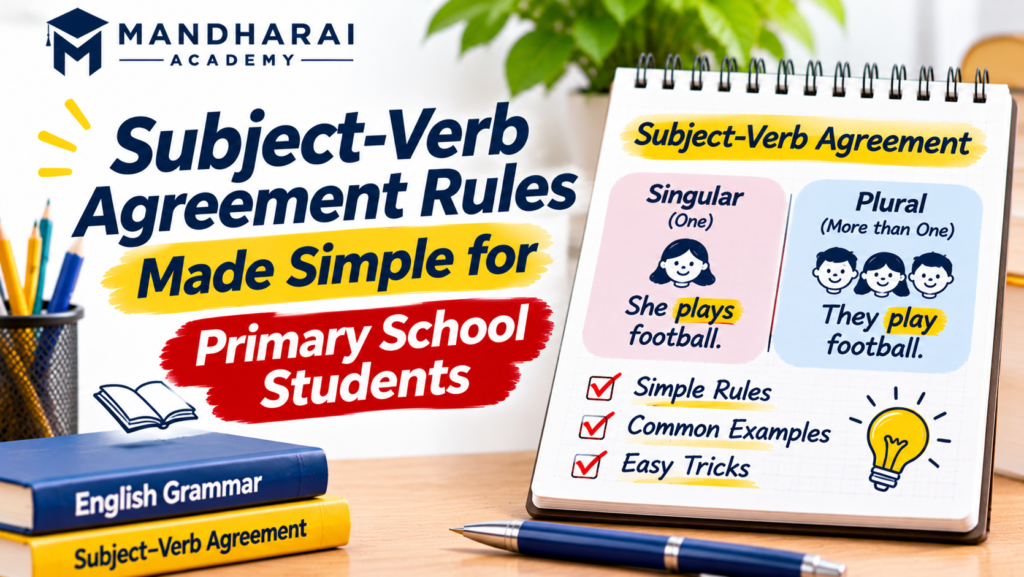
Subject-Verb Agreement Rules Made Simple for Primary School Students
Have you ever wondered why we say “She plays football” but “They play football”?
The answer is Subject-Verb Agreement. It is an important English grammar concept that helps students construct correct sentences and communicate clearly.
For Class 5 students preparing for the All India Sainik Schools Entrance Examination (AISSEE) 2027, understanding verbs, singular and plural forms, and sentence formation can strengthen their English language skills.
Subject-Verb Agreement becomes easy when children understand a few basic rules and practise them regularly.
Subject-Verb Agreement becomes easy when children understand a few basic rules and practise them regularly.
1. What Is Subject-Verb Agreement?
Subject-Verb Agreement means that the verb in a sentence must match its subject in number and person.
In simple words:
- A singular subject generally takes a singular verb.
- A plural subject generally takes a plural verb.
Examples:
| Incorrect Sentence | Correct Sentence |
|---|---|
| She play cricket. | She plays cricket. |
| They plays cricket. | They play cricket. |
| He go to school. | He goes to school. |
| We goes to school. | We go to school. |
The subject tells us who or what the sentence is about. The verb tells us what the subject does or what happens.
2. Rule 1: Singular Subjects Take Singular Verbs
When the subject refers to one person, animal or thing, the verb usually takes an appropriate singular form.
Examples:
- The boy plays football.
- She reads a book.
- My mother cooks dinner.
- The dog barks loudly.
- He writes neatly.
Remember: In the simple present tense, most verbs take an “s” or “es” with he, she and it.
| Subject | Correct Verb |
|---|---|
| He | Runs |
| She | Reads |
| It | Works |
| My brother | Plays |
| The teacher | Teaches |
3. Rule 2: Plural Subjects Take Plural Verbs
When the subject refers to more than one person, animal or thing, use the appropriate plural verb form.
Examples:
- The boys play football.
- They read books.
- My friends visit me.
- The dogs bark loudly.
- We write neatly.
Notice the difference:
| Singular Subject | Plural Subject |
|---|---|
| The girl sings. | The girls sing. |
| He plays. | They play. |
| The bird flies. | The birds fly. |
| She dances. | They dance. |
| The student writes. | The students write. |
4. Rule 3: Use “Is”, “Am” and “Are” Correctly
“Is”, “am” and “are” are forms of the verb “to be”. They are commonly used to describe people, places, animals and things.
Remember this simple table:
| Subject | Correct Helping Verb |
|---|---|
| I | Am |
| He | Is |
| She | Is |
| It | Is |
| You | Are |
| We | Are |
| They | Are |
Examples:
- I am a student.
- She is happy.
- He is my brother.
- You are kind.
- We are ready.
- They are playing.
Easy memory trick:
- I → Am
- He, She, It → Is
- You, We, They → Are
5. Rule 4: Use “Has” and “Have” Correctly
“Has” and “have” are used to show possession and in certain verb forms.
Use HAS with:
- He
- She
- It
- Singular names and subjects
Use HAVE with:
- I
- You
- We
- They
- Plural subjects
| Subject | Correct Word |
|---|---|
| He | Has |
| She | Has |
| The boy | Has |
| I | Have |
| You | Have |
| We | Have |
| They | Have |
Examples:
- She has a new bag.
- He has a bicycle.
- I have a pencil.
- They have two books.
- We have a test tomorrow.
6. Rule 5: Subjects Joined by “And”
When two subjects are joined by “and”, they generally take a plural verb.
Examples:
- Ravi and Rani are friends.
- My father and mother work together.
- The teacher and the students are in the classroom.
- A cat and a dog play in the garden.
Remember: Two subjects joined by “and” usually behave like a plural subject.
7. Rule 6: Subjects Joined by “Or”
When two subjects are joined by “or”, the verb generally agrees with the subject nearest to it.
Examples:
- The boy or his friends are coming.
- The boys or their teacher is coming.
- Either Ravi or Arun is responsible.
For primary students, first identify the subject closest to the verb and then choose the matching verb.
8. Rule 7: Some Words Take Singular Verbs
Words such as everyone, everybody, someone, somebody, anyone and nobody are treated as singular subjects in standard English grammar.
Examples:
- Everyone is happy.
- Somebody has taken my pencil.
- Nobody knows the answer.
- Each student has a notebook.
- Everybody enjoys the game.
Although these words may refer to many people, they generally take singular verbs.
9. Common Subject-Verb Agreement Mistakes
Students often make mistakes when speaking or writing quickly. Understanding these examples can help them avoid common errors.
| Incorrect | Correct |
|---|---|
| She are my sister. | She is my sister. |
| He have a car. | He has a car. |
| They is playing. | They are playing. |
| The boys runs fast. | The boys run fast. |
| I is happy. | I am happy. |
| Everyone are ready. | Everyone is ready. |
| Ravi and Kumar is friends. | Ravi and Kumar are friends. |
| My mother cook food. | My mother cooks food. |
10. Easy Tricks to Identify the Correct Verb
Students can follow these simple steps whenever they solve a grammar question.
- Find the subject: Identify who or what the sentence is about.
- Check the number: Decide whether the subject is singular or plural.
- Look at the verb: Check whether the verb matches the subject.
- Read the sentence again: Make sure the sentence sounds grammatically correct.
- Practise similar examples: Repeating different sentence patterns improves accuracy.
11. AISSEE 2027 English Grammar Practice
The AISSEE 2027 Class VI Language syllabus includes topics such as Verbs and Type, Number, Kinds of Nouns, Kinds of Pronouns and Sentence Formation.
Subject-Verb Agreement supports students in applying these grammar concepts correctly when forming and understanding sentences.
Here are ten practice questions for Class 5 students.
Q1. Choose the correct sentence.
A) She play tennis.
B) She plays tennis.
C) She playing tennis.
D) She are play tennis.
Q2. The boys _____ football every evening.
A) Plays
B) Playing
C) Play
D) Is playing
Q3. I _____ a student.
A) Is
B) Am
C) Are
D) Be
Q4. My sister _____ a beautiful dress.
A) Have
B) Having
C) Has
D) Are
Q5. They _____ ready for the examination.
A) Is
B) Am
C) Are
D) Has
Q6. Ravi and Kumar _____ good friends.
A) Is
B) Are
C) Am
D) Has
Q7. Everyone _____ happy today.
A) Are
B) Am
C) Is
D) Have
Q8. The dog _____ loudly at night.
A) Bark
B) Barks
C) Barking
D) Are barking
Q9. We _____ English every day.
A) Studies
B) Studying
C) Study
D) Is study
Q10. She _____ to school by bus.
A) Go
B) Goes
C) Going
D) Are going
Answer Key with Explanations
| Question | Correct Answer | Explanation |
|---|---|---|
| 1 | B) She plays tennis. | She is singular. |
| 2 | C) Play | Boys is plural. |
| 3 | B) Am | Use “am” with I. |
| 4 | C) Has | Sister is singular. |
| 5 | C) Are | Use “are” with they. |
| 6 | B) Are | Two subjects are joined by and. |
| 7 | C) Is | Everyone takes a singular verb. |
| 8 | B) Barks | Dog is singular. |
| 9 | C) Study | We takes the base verb. |
| 10 | B) Goes | She is singular. |
12. A Simple 15-Minute Daily Grammar Practice Plan
Students can improve their grammar by spending a little time every day.
| Activity | Time |
|---|---|
| Revise subject and verb basics | 3 minutes |
| Learn one grammar rule | 4 minutes |
| Write five example sentences | 4 minutes |
| Solve multiple-choice questions | 4 minutes |
| Total | 15 minutes |
Parents can also encourage children to identify subjects and verbs in sentences from their school textbooks. This connects grammar learning with everyday reading.
13. How Mandharai Academy Supports AISSEE 2027 Preparation
Learning grammar becomes easier when students receive clear explanations and regular practice.
Mandharai Academy provides structured online coaching for AISSEE aspirants through:
- Live online classes.
- Recorded learning sessions.
- Topic-wise worksheets.
- Weekly tests and assessments.
- Doubt clarification.
- Personal mentoring.
- Regular progress updates for parents.
Students can strengthen their English fundamentals through guided lessons, practice exercises and consistent revision.
Conclusion
Subject-Verb Agreement is one of the basic building blocks of English grammar. By learning how singular and plural subjects work with verbs, students can write better sentences and avoid common grammar mistakes.
For AISSEE 2027 preparation, children should practise Subject-Verb Agreement alongside the other prescribed Language topics, including verbs, number and sentence formation.
A few minutes of daily practice can help primary school students build stronger grammar skills and greater confidence in English.
Help your child prepare confidently for AISSEE 2027.
Contact Mandharai Academy for structured online coaching and English language practice.
- Call / WhatsApp: +91 9442455489
- Email: mandharaiacademy@gmail.com
- Website: https://mandharaiacademy.com/
- Instagram: https://www.instagram.com/mandharaiacademy/