
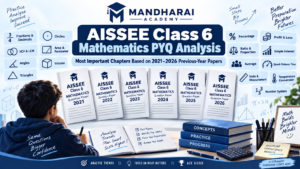
Most Important Mathematics Chapters for AISSEE Class 6 Based on PYQs
A parent opens the AISSEE Mathematics syllabus and sees topics ranging from fractions and percentages to Roman numerals, geometry, averages and unit conversions.
The immediate question is:
“Which chapters should my child concentrate on first?”
Every chapter in the syllabus matters. However, an analysis of the 2021–2026 question papers shows that some AISSEE Class 6 Mathematics Chapters appear more consistently and through a wider variety of question models.
Mandharai Academy reviewed 300 Mathematics questions—50 questions from each of the six papers—to identify:
- Chapters appearing consistently across the years
- Recurring question models
- Concepts tested in different forms
- Changes in question presentation
- Chapters requiring more preparation time
- Topics that can provide dependable marks
The biggest finding is simple:
AISSEE repeatedly tests the same mathematical foundations, but changes the numbers, situations and presentation.
Therefore, students should not search for questions that will repeat exactly. They should master the concepts and models that repeatedly return.
Quick Answer: The Most Important AISSEE Maths Chapters
Based on the 2021–2026 papers, these are the highest-priority chapter groups:
- Fractions and decimals
- Angles, circles and triangles
- Number system and operations
- Area, perimeter and volume
- Percentage, profit and loss
- Ratio, proportion and unitary method
- HCF, LCM and divisibility
- Measurement and unit conversion
- Average
- Speed, distance and time
- Simple interest
- Roman numerals
- Simplification and BODMAS
- Temperature conversion
- Data interpretation
This is a preparation priority—not an official chapter-wise weightage list. The number of questions from an individual topic can vary from year to year.
How We Ranked the AISSEE Class 6 Mathematics Chapters
The ranking is based on three factors.
Frequency
Did the chapter or its closely related concepts appear in several papers?
Variety
Was the chapter tested through more than one model?
For example, fractions appeared through:
- Comparison
- Ascending and descending order
- Addition and subtraction
- Remaining quantity
- Reciprocal
- Decimal conversion
- Word problems
Scoring importance
Can strong preparation in the chapter help a student answer several questions accurately?
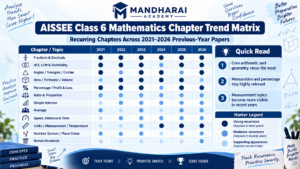
The approximate frequency bands below describe the recurrence observed in the attached paper sets. They should not be treated as a guarantee of the exact AISSEE 2027 distribution.
| Priority | Chapter group | Presence across 2021–2026 | Observed importance |
|---|---|---|---|
| 1 | Fractions and decimals | 6 out of 6 papers | Very high |
| 2 | Geometry: angles, circles and triangles | 6 out of 6 | Very high |
| 3 | Number system and operations | 6 out of 6 | Very high |
| 4 | Mensuration: area, perimeter and volume | 6 out of 6 | Very high |
| 5 | Percentage, profit and loss | 6 out of 6 | High |
| 6 | Ratio, proportion and unitary method | 6 out of 6 | High |
| 7 | HCF, LCM and divisibility | 6 out of 6 | High |
| 8 | Measurement and unit conversion | 6 out of 6 | High |
| 9 | Average | Seen consistently | Medium to high |
| 10 | Speed, distance and time | Seen consistently | Medium to high |
| 11 | Simple interest | Seen in multiple papers | Medium |
| 12 | Roman numerals | 6 out of 6 | Medium |
| 13 | Simplification and BODMAS | Seen regularly | Medium |
| 14 | Temperature | Stronger in recent papers | Medium |
| 15 | Data interpretation | Appeared occasionally | Variable |
Students should first understand the complete AISSEE Class 6 syllabus and exam pattern before using this priority order.
AISSEE Class 6 Mathematics Chapters: Tier 1 Priority
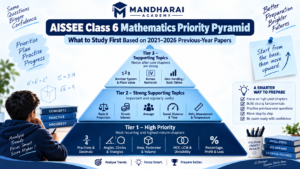
Tier 1 contains chapters that were repeatedly tested and produced several question models. These chapters deserve the most teaching, practice and revision time.
1. Fractions and Decimals
Fractions and decimals appeared in every paper from 2021 to 2026.
Common question models included:
- Finding the smallest or greatest fraction
- Arranging fractions in ascending order
- Arranging fractions in descending order
- Finding equivalent fractions
- Adding and subtracting fractions
- Finding the remaining fraction
- Finding the reciprocal of an expression
- Converting a fraction into a decimal
- Decimal addition and subtraction
- Applying fractions to time, cloth, books or quantities
How the questions evolved
In some papers, students were directly asked to compare fractions. In others, the same concept appeared inside a real-life situation.
For example, a child may be asked to calculate:
- The fraction of a pole painted in a particular colour
- The quantity of cloth remaining after some is used
- The part of a book read within a given time
- The total weight after adding decimal quantities
This chapter tests conceptual clarity as well as calculation accuracy.
Preparation strategy
Students should practise:
- Converting fractions to a common denominator
- Comparing fractions using cross-multiplication
- Changing improper fractions into mixed fractions
- Performing the four basic operations
- Connecting fractions with decimals
- Solving word problems without skipping units
Fractions and decimals should be practised almost every day because they also support percentage, ratio, average and commercial arithmetic.
2. Geometry: Angles, Circles and Triangles
Geometry was another dominant area across the six papers.
Questions repeatedly covered:
- Acute, right, obtuse, straight and reflex angles
- Complementary angles
- Supplementary angles
- Angles in diagrams
- Properties of circles
- Radius, diameter, chord and arc
- Classification of triangles
- Statements about lines and shapes
- Matching geometric terms with definitions
Why this chapter causes mistakes
Students may remember that complementary angles add up to 90° and supplementary angles add up to 180°. The difficulty begins when the question says:
- One angle is a fraction of a right angle
- Another angle is a multiple of that angle
- The supplement or complement must be calculated
- The resulting angle must then be classified
Recent papers also used:
- Statement I and Statement II
- Assertion and reason
- Match List I with List II
- Diagram-based identification
This shows that learning definitions alone is insufficient.
Preparation strategy
Create one visual revision page containing:
- Every type of angle
- Complementary and supplementary relationships
- Parts of a circle
- Types of triangles by sides
- Types of triangles by angles
- Basic line and plane properties
Students should then practise both direct and statement-based questions.
3. Number System and Operations
The number system is spread across several parts of the syllabus and appeared throughout the six-year period.
Recurring areas included:
- Place value and face value
- Greatest and smallest numbers
- Forming numbers using given digits
- Successor and predecessor
- International and Indian number systems
- Addition and subtraction of large numbers
- Prime and composite numbers
- Multiples and factors
- Divisibility
- Number patterns
- Properties of operations
Question styles found in the papers
Students were asked to:
- Form the smallest number using selected digits
- Find the place value of a digit
- Compare large numbers
- Identify prime or composite numbers
- Check divisibility statements
- Find the sum of selected prime numbers
- Interchange digits and calculate a new value
- Determine whether a mathematical statement is correct
These questions may look simple, but close answer choices make careless mistakes costly.
Preparation strategy
Students must become confident with:
- Reading large numbers
- Zero placement
- Digit restrictions
- Divisibility rules
- Prime numbers within common ranges
- Basic properties such as closure and distributivity
4. Area, Perimeter and Volume
Mensuration appeared consistently from 2021 through 2026.
Common question models included:
- Area of squares and rectangles
- Perimeter of regular and irregular figures
- Cost of fencing
- Multiple rounds around a field
- Area of shaded or unshaded regions
- Volume of cubes and cuboids
- Melting and reshaping solids
- Joining cubes to form a cuboid
- Capacity of tanks and containers
Why mensuration is important
A single problem may combine:
- Unit conversion
- A formula
- Multiplication
- Cost calculation
- Careful interpretation of a diagram
For example, students may know the perimeter formula but forget to multiply it by the number of fencing rounds.
Preparation strategy
For every formula, students should practise three levels:
- Direct formula questions
- Real-life word problems
- Figure-based multi-step questions
They should always write the correct unit:
- cm or m for length
- cm² or m² for area
- cm³ or m³ for volume
5. Percentage, Profit and Loss
Commercial arithmetic appeared regularly across the papers.
The most common models were:
- Finding a percentage of a number
- Finding the original number from its percentage
- Percentage increase
- Profit percentage
- Loss percentage
- Finding cost price or selling price
- Comparing transactions
- Percentage-based word problems
The questions used relatable situations involving:
- Shops
- Books
- Mobile phones
- Fuel prices
- Examination marks
- Products bought and sold
Preparation strategy
Students should clearly understand the difference between:
- Cost price and selling price
- Profit and profit percentage
- Loss and loss percentage
- Percentage value and original value
- Increase amount and percentage increase
The chapter should be taught conceptually before introducing shortcuts.
6. Ratio, Proportion and Unitary Method
These topics appeared in practical situations throughout the six papers.
Common models included:
- Dividing money in a ratio
- Comparing two quantities
- Finding an unknown term in a proportion
- Cost of a given number of objects
- Work completed by people
- Quantities consumed by animals
- Investment and profit sharing
- Finding the cost or quantity of one unit
Preparation strategy
Students should learn to recognise the difference between:
- A simple ratio
- Equivalent ratios
- Direct proportion
- Inverse proportion
- Unitary method
- Division of a quantity in a given ratio
Unitary-method questions are often hidden inside ordinary stories. Students must first identify the value of one unit and then calculate the required number of units.
7. HCF, LCM and Divisibility
HCF and LCM appeared through highly recognisable models in every year.
Recurring formats included:
- HCF and LCM of two numbers
- Finding one number when the other number is given
- Greatest possible equal length
- Largest equal group
- Least number divisible by several numbers
- Same remainder problems
- Divisibility statements
- Cutting rods or cloth into equal pieces
The key decision
Students must learn when to use HCF and when to use LCM.
Use HCF when the question asks for:
- Greatest possible size
- Longest equal piece
- Largest equal group
- Maximum measurement
Use LCM when it asks for:
- Smallest common quantity
- Least number divisible by several numbers
- Events occurring together
- Minimum number satisfying multiple conditions
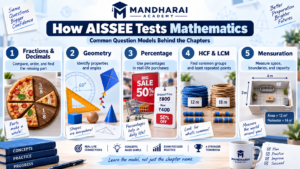
AISSEE Class 6 Mathematics Chapters: Tier 2 Priority
Tier 2 chapters are also important, but they generally produce fewer questions or depend on Tier 1 fundamentals.
8. Measurement and Unit Conversion
The papers repeatedly tested:
- Kilograms and grams
- Litres and millilitres
- Metres and centimetres
- Hours, minutes and seconds
- Money and decimal values
- Converting one unit into another
The recent papers used multi-step situations where students first converted the units and then performed addition, subtraction or division.
A reliable habit is:
Convert every quantity into the same unit before calculating.
9. Average
Average appeared through:
- Direct average
- Finding a missing value
- Combined average
- Average marks
- Average weight
- Average runs
- Average temperature
Students should not merely memorise:
Average = Total ÷ Number of observations
They must also rearrange it:
Total = Average × Number of observations
This is especially useful in missing-value and combined-average problems.
10. Speed, Distance and Time
Questions included:
- Finding time from distance and speed
- Finding distance travelled
- Comparing two speeds
- Calculating a reduced journey time
- Converting hours into minutes
- Converting kilometres per hour into metres per second
Students should master:
- Distance = Speed × Time
- Speed = Distance ÷ Time
- Time = Distance ÷ Speed
Unit conversion is the main source of error in this chapter.
11. Simple Interest
Simple interest appeared in several papers through loans, investments and repayment situations.
Students should understand:
Simple Interest = Principal × Rate × Time ÷ 100
Questions may ask for:
- Interest
- Principal
- Rate
- Time
- Total amount
- Remaining repayment
The question may provide the amount rather than the interest, so students must know:
Amount = Principal + Interest
12. Roman Numerals
Roman numerals appeared in all six papers.
The common models included:
- Converting ordinary numbers into Roman numerals
- Converting Roman numerals into numbers
- Identifying an incorrect representation
- Performing arithmetic with Roman numerals
- Checking Roman-numeral rules
Because this is a small chapter with consistent recurrence, it can offer dependable marks after focused practice.
Students should revise:
- I, V, X, L, C, D and M
- Repetition rules
- Subtraction rules
- Invalid combinations
- Conversion up to the syllabus limit
AISSEE Class 6 Mathematics Chapters: Emerging Question Styles
The concepts remained familiar, but the presentation became more varied from 2023 onward.
Recent papers increasingly included:
- Statement I and Statement II
- Assertion-and-reason questions
- Match-the-list questions
- Multi-step real-life situations
- Diagram-based geometry
- Questions combining two chapters
- Answer options designed around common errors
For example, a question may combine:
- Percentage with profit and loss
- Fractions with time
- HCF with measurement
- Perimeter with cost
- Speed with unit conversion
- Volume with melting and reshaping
Therefore, chapter-wise practice alone is not enough. Students also need mixed-topic tests.
What Should Students Practise Every Day?
A balanced daily Mathematics routine can be completed in approximately 45–60 minutes.
Daily practice structure
- 10 minutes: Mental calculation
- 15 minutes: One priority concept
- 20 minutes: PYQ-model MCQs
- 10 minutes: Error correction
- 5 minutes: Formula revision
Daily calculation skills
Students should regularly practise:
- Multiplication tables
- Division
- Decimal operations
- Fraction simplification
- Percentage equivalents
- Squares of common numbers
- Unit conversions
- Prime numbers
- Divisibility rules
Speed should be developed only after accuracy becomes stable.
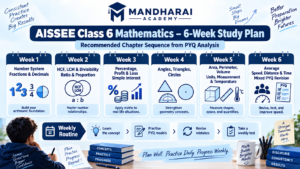
Six-Week Chapter Priority Plan
| Week | Primary chapters | Supporting chapters |
|---|---|---|
| 1 | Number system and operations | Roman numerals and simplification |
| 2 | Fractions and decimals | Measurement |
| 3 | Ratio, proportion and unitary method | Percentage |
| 4 | Profit, loss and simple interest | Average |
| 5 | Angles, circles and triangles | Lines and plane figures |
| 6 | Area, perimeter and volume | Speed, distance, time and temperature |
At the end of each week:
- Attempt one chapter-wise test.
- Record every incorrect answer.
- Identify the reason for each mistake.
- Revise the weakest model.
- Reattempt the incorrect questions.
Students can use the Mandharai Academy AISSEE 2027 Test Series for topic-wise testing and full-length mock examinations.
A Relatable Parent and Student Scenario
Consider a student named Kavin.
Kavin spends an entire week solving simple addition, subtraction and multiplication questions because they make him feel confident. However, his mock-test report shows repeated mistakes in:
- Fraction comparison
- Supplementary angles
- HCF word problems
- Percentage questions
- Unit conversion
His mother responds by buying another Mathematics book. Kavin begins the new book from Chapter 1 and repeats the same comfortable questions.
The real problem is not a lack of books. It is a lack of targeted correction.
A better approach would be:
- Choose one weak chapter.
- Identify the exact model causing mistakes.
- Revise the concept.
- Solve 10–15 similar questions.
- Attempt a timed chapter test.
- Recheck the same skill after one week.
Within a month, Kavin’s score can improve because his preparation is now based on evidence rather than comfort.
How Parents Can Track Mathematics Progress
Parents do not have to teach every formula. They can support preparation by checking four indicators:
Accuracy
How many questions were answered correctly?
Speed
How long did the student take?
Error type
Was the error caused by concept, calculation, reading or time pressure?
Retention
Can the student solve the same model correctly after one week?
A simple progress table can be maintained:
| Chapter | First-test score | Main mistake | Reattempt score | Status |
|---|---|---|---|---|
| Fractions | 6/10 | Comparison error | 9/10 | Improving |
| Angles | 5/10 | Formula confusion | 8/10 | Revise |
| HCF and LCM | 8/10 | Word-problem identification | 10/10 | Strong |
This gives parents useful information without increasing pressure on the child.
Common Mathematics Preparation Mistakes
Avoid these common mistakes:
- Studying only easy chapters
- Memorising formulas without understanding
- Ignoring units
- Solving questions without a timer
- Checking only the final score
- Not reviewing wrong answers
- Practising direct sums but avoiding word problems
- Skipping diagrams and statement-based questions
- Depending entirely on tricks
- Attempting full mock tests before learning the concepts
The objective is not to complete the maximum number of books. It is to build reliable accuracy across the most important models.
Frequently Asked Questions
Which AISSEE Class 6 Mathematics chapter has the highest weightage?
NTA does not announce a guaranteed chapter-wise distribution. Based on the six papers analysed, fractions, geometry, number concepts, mensuration and commercial arithmetic form the strongest recurring clusters.
Can students skip low-frequency chapters?
No. A lower-frequency chapter can still contribute valuable marks. The ranking should determine preparation time, not decide which chapters to abandon.
Are NCERT Mathematics textbooks enough?
NCERT-level fundamentals are extremely useful, but AISSEE preparation also requires objective questions, time-bound problem-solving, mixed practice and exposure to previous-year models.
How many previous-year papers should a student solve?
Students should ideally work through all six papers from 2021 to 2026. The first papers can be used for learning and analysis. Later papers should be attempted under timed examination conditions.
Where should a weak student begin?
Begin with number operations, fractions and basic geometry. These foundations support several other chapters. Move to percentages, ratio, mensuration and speed only after the basic calculations become dependable.
Final Takeaway
The analysis of Mathematics questions from 2021 to 2026 shows that successful AISSEE preparation should be based on priorities—not guesswork.
The most important conclusions are:
- Fractions and decimals require continuous practice.
- Geometry must be understood visually and conceptually.
- Number-system fundamentals support the entire section.
- Mensuration regularly combines formulas with real situations.
- Percentage, profit and loss are dependable scoring areas.
- Ratio and unitary method appear in many disguised forms.
- HCF and LCM models recur consistently.
- Measurement and temperature have become increasingly relevant.
- Recent papers use more statement, matching and multi-step formats.
- Error analysis is essential for score improvement.
The important AISSEE Class 6 Mathematics Chapters should receive more practice time, but the complete syllabus must still be covered.
For structured AISSEE 2027 Class 6 coaching, Mathematics training, PYQ-model practice and mock tests, contact Mandharai Academy:
- Phone/WhatsApp: +91 94424 55489
- Email: mandharaiacademy@gmail.com
- Instagram: Mandharai Academy
- Facebook: Mandharai Academy Facebook
Mandharai Academy’s AISSEE preparation system combines concept-based learning, previous-year question models, regular assessments, doubt clarification and personal mentoring from a Sainik School alumnus.
Start with the most important chapter, identify the weakest question model and improve it systematically.