

How to Improve Calculation Speed for AISSEE Class 6 Mathematics
A student understands percentages perfectly at home. Give the child one question, and the correct answer arrives in three minutes. But during an AISSEE mock test, the same student has to solve fractions, averages, HCF–LCM, profit and loss, geometry, unit conversions and word problems one after another.
Suddenly, three minutes per question feels far too long.
This is the difference between knowing Mathematics and being able to use Mathematics efficiently in an entrance examination.
Parents often assume that slow calculation means a child is weak in Maths. That is not always true. In many cases, the student understands the concept but lacks number familiarity, calculation habits, question selection and timed practice.
To improve calculation speed for AISSEE Class 6, students need more than a collection of tricks. They require a structured system that combines:
- Strong number facts
- Correct written methods
- Mental calculation
- Estimation
- Question-pattern recognition
- Regular timed practice
- Error analysis
The AISSEE Class 6 Mathematics papers supplied from 2021 to 2026 show repeated calculation demands across fractions, decimals, percentages, averages, ratios, commercial arithmetic, mensuration, time, speed, HCF–LCM and multi-step word problems.
The numbers change every year, but the calculation skills remain largely the same.
Important: Calculation speed should never be developed at the cost of accuracy. The goal is not to calculate recklessly. It is to remove unnecessary steps while preserving a reliable method.
Why Improve Calculation Speed for AISSEE Class 6?
The supplied AISSEE papers contain 50 Mathematics questions. These questions are part of a larger examination that also includes Language, Intelligence and General Knowledge.
A child who spends too much time on the Mathematics section may face three problems:
- Difficult questions are attempted before easy ones.
- Enough time is not left for checking.
- The remaining sections are answered under pressure.
Even when the child knows the method, slow calculation can create unnecessary stress.
Consider a percentage question. A student may understand that percentage means “out of 100,” but if calculating 15%15\% of 240 takes several written steps, the student will lose valuable time.
Likewise, a fractions question becomes slower when the student has to calculate basic multiplication tables repeatedly.
Calculation speed matters particularly in chapters such as:
- Fractions
- Decimals
- Percentage
- Ratio and proportion
- Average
- Profit and loss
- Simple interest
- HCF and LCM
- Time, speed and distance
- Perimeter and area
- Volume
- Temperature conversion
- Data interpretation
- Multi-step word problems
Students can review these areas alongside the latest AISSEE Class 6 syllabus. Official notifications should be checked through the NTA AISSEE portal and the Sainik Schools Society.
What the 2021–2026 Mathematics Papers Reveal
The supplied previous-year papers show that AISSEE Mathematics is not based only on direct calculations.
Questions frequently require students to:
- Understand a word problem
- Select the appropriate formula
- Convert units
- Perform two or three calculations
- Compare similar options
- Check whether the result is reasonable
Recurring calculation models included:
| Area | Calculation demand |
|---|---|
| Fractions | Comparison, operations, equivalent fractions and word problems |
| Decimals | Addition, subtraction, comparison and conversion |
| Percentage | Finding a percentage, reverse percentage and percentage change |
| Profit and loss | Cost price, selling price and percentage |
| Ratio | Simplification, division of quantities and applications |
| Average | Finding the mean and missing values |
| HCF–LCM | Direct computation and application-based problems |
| Time and speed | Conversion between hours and minutes and speed-based calculations |
| Mensuration | Perimeter, area and volume |
| Simple interest | Principal, rate, time, interest and amount |
| Temperature | Celsius and Fahrenheit conversion |
| Units | Length, mass, capacity and time conversions |
This means calculation speed is not merely about multiplying quickly. It includes recognising the correct operation and organising the steps efficiently.
How to Improve Calculation Speed for AISSEE Class 6: Build Number Fluency
Number fluency means being comfortable with numbers without recalculating basic facts every time.
Students should learn the following thoroughly:
- Multiplication tables from 1 to 20
- Tables from 21 to 25 for faster advanced calculations
- Squares from 1 to 30
- Cubes from 1 to 10
- Common factors
- Common multiples
- Divisibility rules
- Number bonds to 10, 50, 100 and 1,000
- Common fraction-decimal-percentage conversions
Essential fraction and percentage facts
| Fraction | Decimal | Percentage |
|---|---|---|
| 1/21/2 | 0.5 | 50% |
| 1/41/4 | 0.25 | 25% |
| 3/43/4 | 0.75 | 75% |
| 1/51/5 | 0.2 | 20% |
| 2/52/5 | 0.4 | 40% |
| 3/53/5 | 0.6 | 60% |
| 4/54/5 | 0.8 | 80% |
| 1/101/10 | 0.1 | 10% |
| 1/81/8 | 0.125 | 12.5% |
| 3/83/8 | 0.375 | 37.5% |
| 5/85/8 | 0.625 | 62.5% |
These facts appear indirectly in percentage, profit, ratio and fraction questions.
For example:
25% of 360=14×360=9025\% \text{ of } 360 = \frac{1}{4} \times 360 = 90
A student who recognises 25%=1/425\% = 1/4 can solve the question faster than one who uses a long percentage formula.

Develop Mental Maths Without Skipping Logic
Mental Maths should simplify safe calculations. It should not force the child to hold a long multi-step solution entirely in memory.
Break numbers into convenient parts
Instead of calculating:
47+3847 + 38
Think:
47+30+8=77+8=8547 + 30 + 8 = 77 + 8 = 85
For multiplication:
24×1724 \times 17
Think:
24×(10+7)24 \times (10 + 7) 240+168=408240 + 168 = 408
Use complements
For subtraction:
1000−4871000 – 487
Find what must be added to 487 to reach 1,000:
487+500=987487 + 500 = 987 987+13=1000987 + 13 = 1000
Therefore:
1000−487=5131000 – 487 = 513
Multiply by 5, 25 and 50 efficiently
To multiply by 5:
86×5=86×102=43086 \times 5 = 86 \times \frac{10}{2} = 430
To multiply by 25:
48×25=48×1004=120048 \times 25 = 48 \times \frac{100}{4} = 1200
To multiply by 50:
34×50=34×1002=170034 \times 50 = 34 \times \frac{100}{2} = 1700
These strategies are useful only after the child understands why they work.
Use percentage chunks
To find 15%15\% of 240:
10% of 240=2410\% \text{ of } 240 = 24 5% of 240=125\% \text{ of } 240 = 12 15% of 240=24+12=3615\% \text{ of } 240 = 24 + 12 = 36
Similarly:
- 20% means divide by 5.
- 25% means divide by 4.
- 50% means divide by 2.
- 75% means find three-fourths.
- 10% means divide by 10.
- 5% means half of 10%.
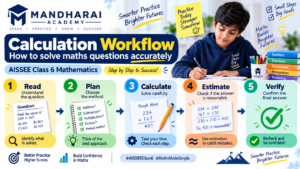
Improve Calculation Speed for AISSEE Class 6 Using Estimation
Estimation helps students reject impossible options and detect calculation mistakes.
Suppose the options are:
- 2,950
- 3,050
- 30,500
- 305
If the calculation is approximately 60×5060 \times 50, the answer must be close to 3,000. The student can immediately eliminate 30,500 and 305.
Estimation is useful in:
- Decimal calculations
- Percentage problems
- Multiplication
- Division
- Profit and loss
- Area and volume
- Average
- Unit conversion
Round before checking
For:
198×31198 \times 31
Estimate:
200×30=6000200 \times 30 = 6000
Therefore, the final answer should be reasonably close to 6,000.
If the student calculates 61,380, the estimate immediately reveals that a place-value error has occurred.
Estimation does not replace the exact calculation when the options are close. It acts as a safety check.
Use Cancellation in Fractions and Percentages
Students often multiply large numbers first and simplify later. This creates unnecessary work.
Consider:
1825×75\frac{18}{25} \times 75
Cancel before multiplying:
75÷25=375 \div 25 = 3
Therefore:
18×3=5418 \times 3 = 54
For:
2436×45\frac{24}{36} \times 45
First simplify:
2436=23\frac{24}{36} = \frac{2}{3}
Then:
23×45=30\frac{2}{3} \times 45 = 30
Cancellation reduces both time and the chance of calculation errors.
Students should look for common factors before multiplying numerators and denominators.
Improve Calculation Speed for AISSEE Class 6 in High-Frequency Chapters
Different chapters require different speed-building methods.
Fractions
Students should practise:
- Finding the LCM of denominators
- Converting mixed numbers
- Comparing fractions
- Simplifying before multiplication
- Taking reciprocals during division
Before adding fractions, check whether one denominator is already a multiple of the other.
For example:
34+58\frac{3}{4} + \frac{5}{8}
Since 8 is a multiple of 4:
34=68\frac{3}{4} = \frac{6}{8}
Therefore:
68+58=118\frac{6}{8}+\frac{5}{8}=\frac{11}{8}
Decimals
Students should:
- Align decimal points
- Add zeros when helpful
- Estimate the answer
- Check place value
- Avoid removing decimal points carelessly
For example:
6.7850−2.46246.7850 – 2.4624
Writing the numbers in aligned columns prevents place-value errors.
Percentage
Students should understand the relationship between:
- Fraction
- Decimal
- Percentage
- Ratio
They should practise:
- Percentage of a quantity
- Finding the whole quantity
- Percentage increase
- Percentage decrease
- Profit and loss percentages
HCF and LCM
Speed improves when students:
- Know prime numbers
- Recognise divisibility
- Use prime factorisation correctly
- Understand when a question requires HCF and when it requires LCM
Use HCF when the question asks for:
- Greatest possible length
- Largest equal group
- Maximum size
- Equal division without remainder
Use LCM when the question asks for:
- Smallest common time
- First simultaneous occurrence
- Least number divisible by given numbers
Average
Always begin with:
Average=TotalNumber of items\text{Average}=\frac{\text{Total}}{\text{Number of items}}
For missing-value questions:
Required total=Average×Number of items\text{Required total}=\text{Average}\times\text{Number of items}
Then subtract the known values.
Mensuration
Students should memorise essential formulas:
- Rectangle perimeter: 2(l+b)2(l+b)
- Rectangle area: l×bl\times b
- Square perimeter: 4s4s
- Square area: s2s^2
- Triangle area: 12×b×h\frac{1}{2}\times b\times h
- Cuboid volume: l×b×hl\times b\times h
- Cube volume: s3s^3
Writing the formula before substituting numbers prevents confusion between area, perimeter and volume.
Stop Writing Unnecessary Steps
Students sometimes believe that every small calculation requires a long written method. This slows them down and makes the page difficult to review.
Use mental calculation for:
- Basic addition
- Simple subtraction
- Known multiplication facts
- Halves and quarters
- Common percentages
- Simple cancellation
Use written calculation for:
- Long division
- Multi-digit multiplication
- Decimal operations
- Multi-step word problems
- Questions with several unit conversions
- Calculations that must be checked later
A good rule is:
If the calculation can be completed accurately in one or two mental steps, do it mentally. If it contains several dependent steps, write it clearly.
The purpose of rough work is to support thinking, not to display every fact the student knows.
Read the Question Before Calculating
Many so-called calculation errors are actually reading errors.
A student may correctly calculate the area when the question asks for perimeter. Another may calculate simple interest but forget that the required answer is the total amount.
Before starting, underline:
- What is given
- What must be found
- Units
- Keywords
- Conditions such as “more than,” “remaining,” “difference” or “maximum”
For a word problem, write a short mathematical plan.
For example:
Cost of one notebook = total cost ÷ number of notebooks
Cost of required notebooks = cost of one × required number
This takes only a few seconds and can prevent an entire question from going wrong.
Improve Calculation Speed for AISSEE Class 6 with Timed Practice
Speed develops when familiar methods are practised under gradually increasing time limits.
Students should not begin by attempting a full paper at maximum speed. This usually creates anxiety and careless mistakes.
Use three stages.
Stage 1: Untimed accuracy
- Learn the method.
- Solve slowly.
- Write organised steps.
- Aim for at least 90% accuracy.
Stage 2: Topic-based timing
- Solve ten questions from one chapter.
- Record the total time.
- Identify the slowest question.
- Repeat a similar set after two days.
Stage 3: Mixed-question timing
- Mix fractions, percentage, average, HCF–LCM and mensuration.
- Practise switching between methods.
- Use an OMR-style answer sheet occasionally.
- Review both accuracy and time.
The best target is not simply “finish faster.” A useful target is:
Complete the same set with equal or better accuracy in less time.

A Practical 20-Minute Daily Speed Routine
Calculation practice does not have to take an hour every day.
A focused 20-minute routine can be effective.
| Time | Activity |
|---|---|
| 3 minutes | Tables, squares and fraction-percentage recall |
| 5 minutes | Ten basic arithmetic calculations |
| 5 minutes | Five chapter-based calculations |
| 5 minutes | Two or three PYQ-model word problems |
| 2 minutes | Check errors and write one correction rule |
Students can rotate the chapter focus:
- Monday: Fractions
- Tuesday: Decimals
- Wednesday: Percentage and profit-loss
- Thursday: Ratio and average
- Friday: HCF–LCM
- Saturday: Mensuration and units
- Sunday: Mixed speed test
This daily routine is short enough to maintain consistently.
Maintain a Calculation Error Notebook
Every wrong answer should be classified.
Use the following categories:
| Error type | Example |
|---|---|
| Concept error | Used LCM where HCF was required |
| Operation error | Added instead of subtracting |
| Fact error | Recalled a multiplication table incorrectly |
| Place-value error | Misaligned decimal points |
| Unit error | Mixed centimetres and metres |
| Reading error | Found area instead of perimeter |
| Formula error | Used the wrong formula |
| Speed error | Rushed and skipped a step |
| OMR error | Marked a different option |
A student who writes only the correct answer may repeat the same mistake. A student who records the reason can correct the habit.
Once a week, review the notebook and answer:
- Which error occurred most often?
- Which chapter consumed the most time?
- Which calculation fact needs revision?
- Was the wrong answer caused by speed or misunderstanding?

Use a Three-Pass Examination Strategy
Students should not attempt the Mathematics section strictly in question-number order if one difficult question is consuming too much time.
First pass: Quick and familiar
Attempt questions that:
- Have a clear method
- Require one or two calculations
- Use familiar facts
- Can be solved confidently
Second pass: Moderate questions
Return to questions involving:
- Two-step word problems
- Unit conversion
- Percentage applications
- Average or simple interest
- Standard mensuration
Third pass: Lengthy or uncertain questions
Finally attempt:
- Complex figures
- Detailed data interpretation
- Long multi-step problems
- Questions requiring repeated checking
This strategy protects easy marks and prevents one question from controlling the entire paper.
Speed Techniques Students Should Avoid
Not every shortcut is useful.
Avoid:
- Memorising tricks without understanding
- Doing long decimal calculations entirely mentally
- Skipping units
- Using different methods every day
- Rushing before achieving accuracy
- Depending on calculators during practice
- Learning advanced shortcuts that work only for rare number patterns
- Copying an online trick without verifying it
A method is valuable only when the student can explain it and use it correctly under pressure.

A Six-Week Calculation-Speed Plan
Week 1: Number facts
Revise:
- Tables
- Squares
- Cubes
- Divisibility
- Factors and multiples
- Number bonds
Week 2: Fractions and decimals
Practise:
- Simplification
- Comparison
- Operations
- Reciprocals
- Decimal alignment
- Fraction-decimal conversion
Week 3: Percentage and commercial arithmetic
Cover:
- Percentage of a number
- Percentage change
- Profit and loss
- Simple interest
- Discount models
Week 4: Ratio, average and unit conversion
Practise:
- Equivalent ratios
- Division in a ratio
- Missing averages
- Time conversion
- Length, mass and capacity
Week 5: Mensuration and speed problems
Cover:
- Perimeter
- Area
- Volume
- Time-speed-distance
- Temperature conversion
- Mixed word problems
Week 6: PYQs and mock tests
Complete:
- Topic-wise PYQ revision
- Mixed calculation tests
- Timed Mathematics sections
- Error-log revision
- Full-length mock examinations
An AISSEE online test series helps students measure both accuracy and solving time across mixed question types.
A Relatable Student Scenario
Imagine two students who both score 32 out of 50 in their first Mathematics mock test.
The first student responds by solving more random questions every day. The child works hard but continues to repeat decimal and unit-conversion mistakes.
The second student analyses the paper. Of the 18 incorrect questions:
- Five were calculation errors.
- Four were caused by weak tables.
- Three involved unit conversion.
- Two used the wrong formula.
- Four were left unanswered because of time.
The second student spends the next two weeks strengthening these exact weaknesses. The child practises tables, completes decimal drills, writes units in every step and uses a three-pass test strategy.
Both students may solve the same number of practice questions, but the second student’s preparation is more likely to improve the score.
Speed grows faster when practice is based on diagnosed weaknesses.
How Parents Can Help Without Creating Pressure
Parents can support calculation speed by:
- Conducting short oral calculation games
- Asking everyday Maths questions while shopping
- Timing only familiar questions
- Praising improved accuracy
- Avoiding comparisons with other children
- Reviewing the error notebook once a week
- Encouraging estimation
- Allowing rough work
- Maintaining a consistent routine
Do not repeatedly tell the child, “You are too slow.”
Instead, ask:
- Which step took the most time?
- Is there a smaller calculation fact we can strengthen?
- Can we find a cleaner method?
- Was the answer close to the estimate?
The aim is to build confidence and control, not fear of the clock.
Improve Calculation Speed for AISSEE Class 6: Final Takeaway
Calculation speed is not a special talent that some children naturally possess. It is the result of organised practice.
Students should:
- Strengthen tables and number facts
- Learn common fraction-percentage relationships
- Simplify before multiplying
- Use estimation
- Align decimals carefully
- Memorise essential formulas
- Read the question before calculating
- Practise under gradual time limits
- Maintain an error notebook
- Use a three-pass examination strategy
Most importantly, build accuracy first. Once the method becomes stable, speed follows naturally.
Mandharai Academy’s AISSEE Class 6 Coaching combines concept teaching, PYQ-based practice, calculation drills, weekly tests, doubt clearing, personal guidance and full-length mock examinations.
For structured AISSEE 2027 exam coaching and Mathematics training, contact us:
- Call or WhatsApp: +91 9442455489
- Email: mandharaiacademy@gmail.com
- Instagram: Mandharai Academy
- Facebook: Follow Mandharai Academy
Practise intelligently, analyse every error and make each calculation cleaner than the previous one.