
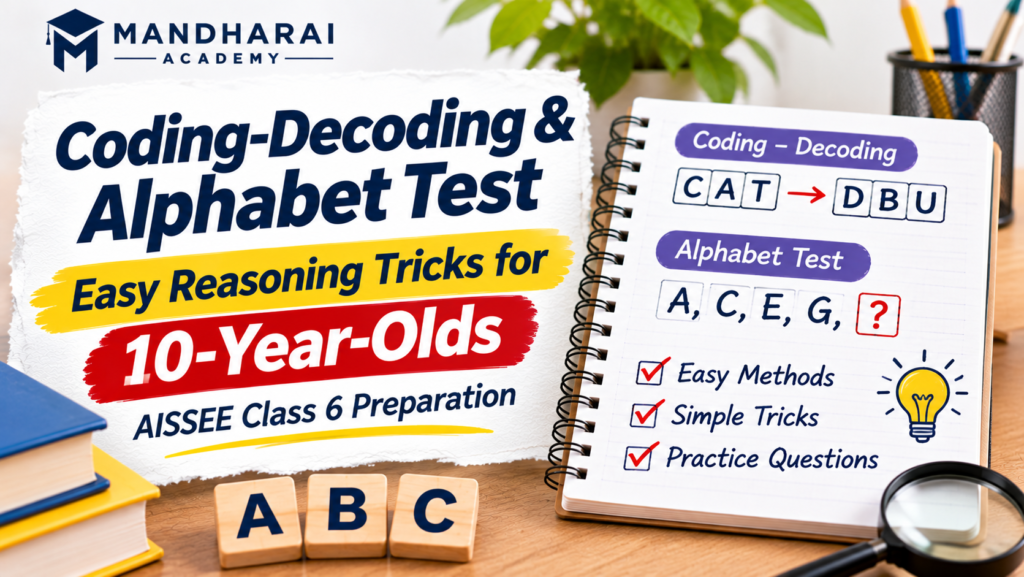
Coding-Decoding & Alphabet Test: Easy Reasoning Tricks for 10-Year-Olds
Preparing for AISSEE 2027 Class 6 admission? Coding-Decoding and Alphabet Test questions are useful practice activities for developing a child’s logical thinking, observation skills and ability to recognise patterns.
These questions may look confusing at first, but most follow simple rules. Once students learn how to identify letter positions, forward and backward movements, and number patterns, they can solve them with greater confidence.
For a Class 5 student, the best approach is to understand the rule first and practise with small examples before attempting timed questions.
1. What Is Coding-Decoding?
Coding-Decoding is a reasoning activity in which letters, words or numbers are changed according to a particular rule. Students must identify the rule and use it to find the correct answer.
Example:
If CAT is written as DBU, how is DOG written?
Look at each letter:
- C becomes D: move one letter forward.
- A becomes B: move one letter forward.
- T becomes U: move one letter forward.
Apply the same rule to DOG:
- D becomes E.
- O becomes P.
- G becomes H.
Answer: EPH
The important skill is identifying the pattern, not memorising the answer.
2. Learn Alphabet Positions First
The first step in solving many alphabet-based reasoning questions is learning the position of each English letter.
| Letter | Position | Letter | Position |
|---|---|---|---|
| A | 1 | N | 14 |
| B | 2 | O | 15 |
| C | 3 | P | 16 |
| D | 4 | Q | 17 |
| E | 5 | R | 18 |
| F | 6 | S | 19 |
| G | 7 | T | 20 |
| H | 8 | U | 21 |
| I | 9 | V | 22 |
| J | 10 | W | 23 |
| K | 11 | X | 24 |
| L | 12 | Y | 25 |
| M | 13 | Z | 26 |
Easy memory trick: Divide the alphabet into smaller groups:
- A–E: 1–5
- F–J: 6–10
- K–O: 11–15
- P–T: 16–20
- U–Z: 21–26
Practise saying the letters and their positions aloud until you can recall them quickly.
3. Easy Coding-Decoding Methods
Method 1: Move One Letter Forward
In this method, every letter is replaced by the next letter in the alphabet.
Example:
If BAT is coded as CBU, how is PEN coded?
- P → Q
- E → F
- N → O
Answer: QFO
Method 2: Move One Letter Backward
Here, every letter is replaced by the previous letter.
Example:
If DOG is coded as CNF, how is CAT coded?
- C → B
- A → Z
- T → S
Answer: BZS
Remember that A moves backward to Z.
Method 3: Move Two Letters Forward
Some questions use a movement of two positions instead of one.
Example:
If ABC is coded as CDE, how is DOG coded?
- D → F
- O → Q
- G → I
Answer: FQI
Method 4: Reverse Alphabet Coding
In reverse alphabet coding, letters are matched with their opposite positions.
| Original | Reverse |
|---|---|
| A | Z |
| B | Y |
| C | X |
| D | W |
| E | V |
| F | U |
| G | T |
| H | S |
| I | R |
| J | Q |
| K | P |
| L | O |
| M | N |
Example:
If A is coded as Z, B as Y and C as X, how is CAB coded?
- C → X
- A → Z
- B → Y
Answer: XZY
Method 5: Number Coding
Letters may also be represented by their alphabet positions.
Example:
If A = 1, B = 2, C = 3 and so on, what is the code for BAD?
- B = 2
- A = 1
- D = 4
Answer: 2 – 1 – 4
4. What Is an Alphabet Test?
Alphabet Test questions check how well students understand the order and positions of letters. They may involve finding missing letters, arranging letters, identifying positions or recognising letter patterns.
Type 1: Find the Missing Letter
Example:
A, C, E, G, __
Observe the pattern: one letter is skipped each time.
A → C → E → G → I
Answer: I
Type 2: Find the Letter at a Given Position
Example:
Which letter is the 8th letter from the beginning of the English alphabet?
A = 1, B = 2, C = 3 …
Answer: H
Type 3: Find the Letter from the End
Example:
Which letter is the 5th letter from the right end of the alphabet?
Z = 1, Y = 2, X = 3, W = 4, V = 5.
Answer: V
Type 4: Arrange Letters in Alphabetical Order
Example:
Arrange these letters in alphabetical order: D, A, C, B.
Correct order: A, B, C, D.
Answer: ABCD
Type 5: Find the Letter Between Two Letters
Example:
Which letter comes exactly between F and J?
F, G, H, I, J.
Answer: H
5. Five Simple Tricks to Solve Questions Faster
- Memorise letter positions: Knowing A = 1 and Z = 26 makes many questions easier.
- Check the movement: See whether letters move forward or backward.
- Look for repeated patterns: Check whether the same rule is applied to every letter.
- Use small groups: Practise five letters at a time instead of memorising the entire alphabet at once.
- Verify your answer: Apply the identified rule again to check whether the answer follows the pattern.
Do not guess immediately. Take a few seconds to understand the rule before selecting an answer.
6. AISSEE 2027 Intelligence Preparation: Why Practise These Questions?
According to the AISSEE 2027 Information Bulletin, the Class 6 Intelligence section carries 25 questions for 50 marks. The listed areas include analogies, patterns, classification, visual and logical reasoning, series and sequences, critical thinking and problem solving, and familial relations.
Coding-Decoding and Alphabet Test are useful supplementary practice formats for building pattern-recognition and logical-reasoning skills. However, they are not separately named as individual topics in the official Class 6 Intelligence topic list. Students should prepare the complete prescribed syllabus rather than depend on only these question types.
For the current AISSEE 2027 admission cycle, students should combine topic-wise reasoning practice with regular revision and mock tests.
7. Practice Questions for Class 5 Students
Try these questions without looking at the answers first.
Q1. If CAT is coded as DBU, how is BAT coded?
A) CBU
B) CAU
C) CBT
D) DBT
Q2. Find the missing letter: B, D, F, H, __
A) I
B) J
C) K
D) L
Q3. If A = 1, B = 2 and C = 3, what is the code for FACE?
A) 6–1–3–5
B) 5–1–3–6
C) 6–2–3–5
D) 6–1–4–5
Q4. Which letter is the 10th letter from the beginning?
A) I
B) J
C) K
D) L
Q5. If each letter moves one position backward, how is DOG coded?
A) CNG
B) CNF
C) EPH
D) DNF
Q6. Which letter is the 3rd letter from the right end?
A) X
B) W
C) Y
D) V
Q7. Find the missing letter: A, D, G, J, __
A) K
B) L
C) M
D) N
Q8. If the reverse alphabet code is used, what is the code for BAD?
A) YZW
B) ZYW
C) YZX
D) XZW
Answer Key with Explanations
| Question | Answer | Explanation |
|---|---|---|
| 1 | A) CBU | Each letter moves one step forward. |
| 2 | B) J | One letter is skipped each time. |
| 3 | A) 6–1–3–5 | F = 6, A = 1, C = 3, E = 5. |
| 4 | B) J | J is the 10th alphabet letter. |
| 5 | B) CNF | Each letter moves one step backward. |
| 6 | A) X | X is third from the right. |
| 7 | C) M | Each letter moves three positions forward. |
| 8 | A) YZW | B → Y, A → Z, D → W. |
8. A Simple Daily Practice Plan
Students do not need to spend hours practising one reasoning topic. A short and consistent routine can help them improve.
| Practice Activity | Time |
|---|---|
| Revise alphabet positions | 5 minutes |
| Solve coding-decoding questions | 10 minutes |
| Practise alphabet tests | 10 minutes |
| Review incorrect answers | 5 minutes |
| Total | 30 minutes |
Parents can encourage children to maintain a small reasoning notebook. They can write down difficult questions, the rules used and the mistakes they made. Revisiting these questions helps improve accuracy.
9. How Mandharai Academy Supports AISSEE 2027 Aspirants
Learning reasoning becomes easier when students receive clear explanations, regular practice and feedback.
Mandharai Academy provides structured AISSEE 2027 online coaching for Class 6 aspirants, including:
- Live online classes and recorded sessions.
- Topic-wise practice worksheets.
- Weekly tests and assignments.
- Doubt-clearing support.
- Mock test practice and performance reviews.
- Personal mentorship from a Sainik School Amaravathinagar alumnus.
The focus is on building strong concepts rather than memorising shortcuts. Students can practise regularly and understand where they need improvement.
Conclusion
Coding-Decoding and Alphabet Test questions become easier when students understand alphabet positions, letter movements and simple patterns. Regular practice helps children improve observation, logical thinking and confidence.
For AISSEE 2027, students should practise these reasoning activities alongside all the other topics listed in the official Intelligence syllabus. A balanced preparation plan, regular tests and careful review of mistakes can make a real difference.
Help your child prepare with the right guidance.
For AISSEE 2027 Class 6 online coaching, contact Mandharai Academy.
- Call / WhatsApp: +91 9442455489
- Email: mandharaiacademy@gmail.com
- Website: https://mandharaiacademy.com/
- Instagram: https://www.instagram.com/mandharaiacademy/